Showing posts with label South Ossetia. Show all posts

Mamuka Areshidze: Need to Consider Recognition of Abkhaz Independence

Mamuka Areshidze:

“We have to take extraordinary measures in order to return not Abkhazia, but to return Abkhazians… If we want to return Abkhazians, we should save them,” Areshidze said.
“Return of Abkhazians will be impossible if we leave them in the situation in which they currently are. Russia is vigorously changing demographic landscape of Abkhazia."
He said that Russia’s policy of encouraging its military personnel serving in Abkhazia and their families to stay in the region after end of service would further change the demographic situation by decreasing already diminished share of ethnic Abkhazians.
He said that independence for Abkhazia should not in any way be unconditional and it should be linked to set of preconditions, including return of refugees and internally displaced persons.

“I am not saying that we should directly give Abkhazia independence and put an end on that. We should put forth preconditions in the context of giving independence, for example return of refugees,” Areshidze said and added that by recognizing Abkhaz independence Tbilisi will distance Sokhumi from Moscow.
“That would be the only way for us to speak with the Abkhazians in presence of the international community without Russia,” Areshidze said.

“I want to say one thing: the time of traditional approaches is over. Our adversary, which has very strong political, diplomatic, as well as military resources, outdistances us in every way. So we have to make such a surprise move which will disarm our adversary – that means the move which will distance our adversary from the Abkhazians,” he said.
The case of South Ossetia is different, Areshidze said."


Civil Georgia

If you like this please Link Back to this article...


U.S. State Department: Freedom of Speech and Press in Georgia

on print media:
" During the year print media frequently criticized senior government officials. However, some individuals affiliated with these papers reported facing pressure, intimidation, and violence for doing so. Few newspapers were commercially viable. Patrons in politics and business typically subsidized newspapers, which were subject to their influence."

on tv-broadcasts:
"The International Research and Exchanges (IREX) Board's media sustainability index report for the year stated that "the ruling elite" exercised significant influence over the primary news companies to "shape the national narrative" and again raised concerns that the majority of media outlets remained split along political fault lines."
"The IREX Board's Media Sustainability Index for the year noted that national television stations rarely broadcast investigative stories. TI/Georgia's November 2009 report raised similar concerns. Rustavi 2, Imedi, and the GPB did not produce investigative reports."

on press-freedom:
"There were reports of direct physical attacks, harassment, and intimidation of journalists by government officials."
"There also were reports of attacks on journalists by nongovernmental actors."

on separatist regions (Abkhazia, South Ossetia):
"Media in the separatist regions of South Ossetia and Abkhazia remained tightly restricted by the de facto authorities and Russian occupying forces."

on freedom of assembly:
"The constitution and law provide for freedom of assembly; however, there were concerns about provisions in the law. During the year authorities permitted demonstrations; of the few large protests, most, but not all, were held without incident."

Read the full article at FINANCIAL / FINCHANNEL

If you like this please Link Back to this article...


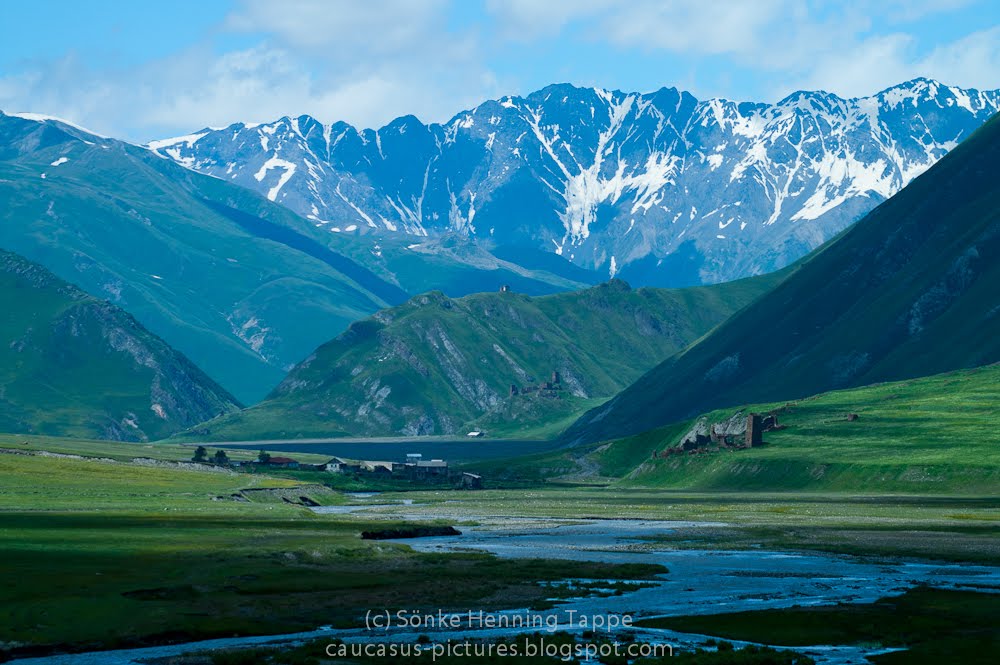
Truso-valley / Truso-Tal


Tensions between Georgia, Russia and self-declared South-Ossetia are running high. Now Kokoity claims the Trusso-valley for South Ossetia. Perhaps the incident Moscow is looking for - another provocation, while russian military continues to build up (not only) in the Akhalgori-region and vows to protect russian citizens.

The truso-valley opens up to the main road connecting Kasbegi with Tbilisi and runs north-east of South-Ossetia. It is therefore of strategic interest. If Kokoity`s militiamen enter the Trusso-valley, Russia might speak of a legitimate cause. (The same, by the way, that made them keep Akhalgori, breaking the six-points-ceasefire-plan). Then, if Saakashvili reacts with force, he fulfills Putin´s desire. If he doesn´t, he becomes a lame duck.

After a few kilometers, which you can still make with a normal car, you reach Okrakana. To go further, you need a good jeep.


Okrakana comprises just half a dozen houses. The valley becomes very narrow (follow the path to the left).


River Terek running through the gorge - the "middle section" of the valley


A wishing-tree. Georgians and Ossetians both pray to St. George.


a horse-rider of unknown origin passing by


After the gorge, the valley opens up again. Note the sedimentary rocks to the left.


Looking back in the direction of the gorge. Detail of sedimentary rocks. There are numerous springs with different waters; apparently, there is also a poisonous one on the other side of the Terek.


The high mountains to the left (SSW) mark, since 2008, the de-facto border to South-Ossetia.


Village of Kertisi. There are very few settlements in Trusso-valley. Many of the houses were in fact abandoned (in 2005).


an Azeri (!) sheperd with his wife


Village of Kertisi. The mountains in the back (about West) mark the border with Russia.


Unconstrained, Russia Eys More Georgian Territories

September 29, 2009

by Giorgi Kvelashvili


"... One year after its military aggression against Georgia, Russia, is apparently trying to not only secure the already impressive territorial gains it has made but to explore the feasibility of more expansion. As was the recent case with navigation in Georgia’s territorial waters along the Abkhazia coast, local adjutants’ claims nearly always precede Russian “concrete” and “decisive” measures, all in the absence of unequivocal international condemnation of the Russian moves.

Arguably, an occupation and annexation of the Truso Valley, let alone of the entire Kazbegi district, is more difficult to justify than the naval control of Georgia’s Abkhazia coast, but given the all-powerful “ethnic” and “humanitarian” nature of the “problem” – as portrayed by the Kremlin – in the Kazbegi district, it would not be impossible for the Russians “to come to the rescue of ethnic Ossetians” once again.

Russia is apparently creating advantageous international conditions to overthrow the pro-Western Saakashvili government in order to complete the process of Georgia’s disintegration."

Full text: GeorgianDaily

If you like this please Link Back to this article...


Paul Rimple:: Signifying mud

One year after the Russia-Georgia war and the scum is still floating on the top. In some cases, it is still rising.
...
The equation was simple. If Bush’s foreign policy was bad, then Saakashvili was bad. Therefore, his enemy Putin must be good. The man that leveled Grozny during his dirty war with Chechnya had suddenly become a victim of the Cheney doctrine. Blah blah blah.

I have friends in Armenia and Abkhazia that really believe the US masterminded the war, based on Russia’s successful propaganda machine and the logic that the US wouldn’t have armed and trained Georgia otherwise. The US can be blamed for lots of things but not for instigating or taking part in last August’s war. The US had repeatedly told Saakashvili to mellow out on the war drum stuff. Renewed conflict would only crush Bush’s big plan to get Georgia into NATO, which it ultimately did.

People also believe that Georgian troops were doped to kill civilians, as that is what the headlines said. The Moscow Bureau for Human Rights (MBHR) interviewed witnesses who claimed that captured Georgian troops had needle marks in their arms. Think about it. Georgian commanders handing out fixes of heroin to their men to help them run over babies in tanks and shoot grandmothers. The logic is compelling.

And as I have mentioned before, people are still stuck on the number of 2000 civilian deaths in Tskhinvali, a number that was accepted before the smoke cleared in the de facto South Ossetian capital, only two days after the August 8th attack. Later, the number fluctuated between 1400-2100, depending on who was reporting. Numbers are good for news. Even Reuters fell for it. It was too late when head of the Russian Prosecutor-General’s investigative committee, Alexander Bastyrkinet, came out with the official civilian death toll of 162 on Christmas 2008. Yet the number is enough for South Ossetia and Russia to claim “genocide” with a straight face, while marauders amped up on the conviction of 2000 deaths systematically destroyed Georgian villages, by flame and bulldozer, displacing tens of thousands people from their homes.

And today, because the Ukraine isn’t playing ball on Russia’s terms, the country has become implicated in the South Ossetia war. Mud flinging is free and easy when the state controls the media and Russia well knows that mud sticks, if you throw enough of it, often enough.

Find the full article here.

If you like this please Link Back to this article...


Who is Kokoity? (South Ossetian Diary by Tbilisi blues)

UPDATE vom 6.8.09

Anlässlich der Absetzung des von Moskau unterstützten bisherigen Regierungschefs Aslanbek Bulazew schreibt Russland Aktuell über Kokoity:

„Schmuggler mit autoritärem Regierungsstil“

Politische Gegner werfen Kokoity nämlich vor, in der Vergangenheit, die schlecht bewachten Grenzen Südossetiens ausnutzend, einen regen Schmuggel vor allem mit Alkohol aufgebaut zu haben. Als Präsident pflegt er seit Jahren einen autoritären Regierungsstil, kritisiert Ex-Premier Oleg Tesijew.

Zuletzt wurde dies bei den Wahlen zum Parlament deutlich: Dort gewann Kokoitys Partei deutlich, nachdem die Opposition von den Wahlen ausgeschlossen wurde. Nun hat der Präsident ein Taschenparlament, um die von ihm gewünschte Verfassungsänderung für eine dritte Amtszeit nach 2011 durchzusetzen.

Kokoity-Clan hat das Sagen

Viele in Moskau lebende Südosseten kritisieren die selbst für russische Verhältnisse enorme Korruption in der kleinen Kaukasusrepublik. Der Kokoity-Clan kontrolliert praktisch alle wichtigen Politikfelder und Wirtschaftszweige. Selbst Premier Bulazew wurde von Kokoity buchstäblich aus der Politik und dem Land gedrängt.

Seit Monaten war Bulazew nicht mehr in Südossetien, ehe er nun wegen „gesundheitlicher Probleme“ zurücktreten musste. Bei einem Besuch von Russlands Präsident Medwedew kürzlich in Zchinwali fiel die Entscheidung, einen Nachfolger für Bulazew zu bestimmen."

Der ganze Artikel findet sich hier.


Original post of May 2009:


If you want to know who exactly South-Ossetia's leader Kokoity is, you might find this article by Paul Rimple, author of "Tbilisi blues'", worth-while:

"Last month I met with Alan Parastayev, the former head of the South Ossetia's North Military HQ during the 1991 war with Georgia, Minister of Interior in 1994-1999 in the Chiborv government, and Chief Justice of South Ossetia's Supreme Court under Kokoity.
In 2005, Kokoity ordered his arrest. Parastayev states the beef stemmed from the illegitimate party lists Kokoity had submitted for upcoming parliamentary elections that he blocked .
Consequently, Parastayev was asked to resign but he refused until his 25 year-old son was imprisoned on a trumped up charge and sentenced to 8 years in prison. Parastayev resigned on the condition his son would be freed, but his captors reneged and he was arrested, beaten and charged for “committing a terrorist act” against de facto MP Bala Bestaute a year earlier by detonating a bomb near his home.
On the pretense of being released, Parastayev was persuaded, after being tortured and drugged, to read a prepared statement stating that the Georgian secret service had offered him US$220,000 to “commit a terrorist act against President Kokoity.” He insists the last line of the text was “but I refused.” That didn't matter to Kokoity.
After 17 months in prison, much of it in solitary confinement, Parastayev was sentenced to 18 years for betraying his homeland and preparing an act of terror against the president.
“I still don't understand what those charges meant,” he says.
When Georgia began its offensive against Tskhinvali in August 2008, the prison was under constant bombardment and authorities opened the gates and set the prisoners free. Parastayev and his son were in Tskhinvali on the 8th and 9th and got word that Kokoity, who had left Tkshinvali on the 6th, discovered prisoners had been freed and ordered the murder of the two Parastayevs. They fled to Georgia where Parasayev now works as the deputy minister of the newly created Ministry of Corrections and Legal Assitance.
Parastayev compares Kokoity's Tskhinvali to the USSR in 1937 where “you can't say a word against Kokoity, nobody dare says their thoughts,” he says. “Until Kokoity came, the word “terrorist” wasn't heard – we didn't have terrorist acts, they came with him."

The full article can be found here.


If you like this please Link Back to this article...


Arms race in the Caucasus (Georgian-Russian Conflict)

Abchazia + South Ossetia / Russian Federation:

"Russland hat laut seinem Nato-Botschafter Dmitri Rogosin das Recht, Abchasien und Südossetien bei Bedarf mit Waffen zu versorgen, damit sich diese vor erneuten Aggressionen schützen können."

(Translation:)
"Russia has the right to supply arms to Abkhazia and South Ossetia, if needed, says Dmitri Rogosin, Russian envoy to NATO. They must be able to defend themselves from renewed hostilities." Full text at RIA Novosti

Truth is, most of the (modern) weaponry will go to the russian military bases there.

Georgia / USA:

Philip J. Crowley, assistant secretary of state, said at a press briefing in Washington on July 23:
...
"Asked if the United States were “contemplating rearming Georgia” Crowley responded: “Georgia is on a path that the United States supports towards NATO membership. Clearly, a fundamental tenant of NATO membership is to have a military that meets NATO standards and would add to the capability of the alliance. So it is logical that the United States would have a military-to-military relationship with Georgia.” Full text at CivilGeorgia

(In fact, most arms come from the Ukraine, some from Israel. The US want to focus on military training, but don´t excluse arms-delivery in the future.)

It is interesting to note that provocations from both sides go on. Examples of the last week: Saakashvili openly hails Lukashenko´s maneuver against Moscow, urging who? to take the road to Sukhumi or Tskhinvali via Georgia proper. (Europe´s last dictator should know better: The roads from Georgia proper to Sukhumi and Tskhinvali are closed for foreigners.)
The russian government continues to launch anti-georgian propaganda. Rogosin mocks NATO and Georgia alike that there were only two choices for Georgia to achievie NATO membership: Accepting the de-facto borders or admitting Abchazia, South Ossetia and russian army bases alike into NATO. Furthermore, Moscow wants to know that the georgian governement plans manifestations on the de-facto border to South Ossetia or even a march into Tskhinvali. In this sweet story, RIA Novosti quotes US Secretary of State Joe Biden telling Michael Saakashvili to listen to his mother´s advice, just as he would listen to his 92-year-old mum himself. Well, you get the idea. (Interestingly, there seems to be no english version.) Finally, Russia is boasting about military advantages over its opponent. It seems as if the russian government desperately stems against the last remaining super-power just for a matter of principle: The more danger, the more honour.

If you like this please Link Back to this article...


Paul Goble: Russian Experts Divided on Probability of New War with Georgia


As Moscow continues a military exercise in the North Caucasus that it says is designed to prevent conflicts, one leading Russian expert says that the probability of a new war between Russia and Georgia may be as high as 80 percent, while another suggests that such predictions themselves constitute “a dangerous provocation.
...
“In the government of Russia, there are no idiots ready to take such steps,” he says, and he offers three reasons for that. First, there are the upcoming negotiations with US President Barak Obama about strategic nuclear weapons, talks which are “important to Russia” and which the outbreak of a conflict could threaten.

Sergey Markedonov, a leading Russian specialist on the Caucasus:
Suppose for a minute that as these talks are going on, “a war with Georgia” breaks out. “What do you think Obama would do? It is not excluded that he would break off the talks and leave,” not an outcome that the Moscow leadership or the American leadership for that matter would be very happy about.
Second, Markedonov argues that “after the recognition of Abkhazia and South Ossetia, Russia is not at all interested in a new escalation of the conflict.” It has its forces and regimes where it wants them. And “if there had been a desire to occupy Tbilisi, this would already have been done in August of last year.”
And third, he points out, “it is necessary to understand that any politician who comes to power after [Georgian President Mikhiel] Saakashvili be it [Irakli] Alasania or [Nino] Burjanadze will not be pro-Russian. And that will be even more true if this [change in Tbilisi] occurs in the course of military actions.
At the same time, Markedonov insists, Georgia too “cannot be interested in a war now” because “many of the illusions [its leadership had last year] have already been dispelled, since the situation now is far from the most favorable.” First of all, Saakashvili “does not have the sympathy of the West” that he did.
Second, “Georgia’s strategic positions are much worse than they were a year ago,” even if one considers that only from the point of view of geography. And third, Georgia, which has received negative comments from European institutions in the past for last year’s conflict, would receive even more negative ones if it appeared that Tbilisi had in any way triggered a new war.
But Markedonov says that the biggest mistake those who predicting a new conflict on the basis of the ongoing maneuvers are making is to assume that the war last year was a rapid reaction “to the events of August 7-8.” In fact, last year’s war was, in Markedonov’s view, “the result of a four-year-long policy of Georgia” and Moscow’s plans to counter it.

Pavel Felgenhauer:
... the probability of a new war is “quite high, from 50 to 80 percent,” with the conflict most likely to begin “in the middle of July ..."
...
First, Moscow’s military maneuvers in the region have grown larger and have become more focused on Georgia than in the past. Second, Georgia can be counted on to do something that Moscow can point to as a provocation.
These Georgian actions may be no more than German claims that the Poles attacked the Germans in 1939 or Soviet suggestions in the same year that the Finns fired on the territory of the USSR. But a similar claim about Georgia will be sufficient not only to allow Moscow to act but to explain its actions to others.
And third, Felgengauer notes, there is an important difference between 2008 and 2009. “In August of last year, Georgia was not planning to fight with Russia; it had prepared for war with the separatists and therefore it suffered complete defeat. Now it is preparing for a war with Russia,” a conflict it cannot win but one that might draw in others on its side.
But the Moscow writer’s clinching argument from his point of view appears to be this: Moscow was able to fight a war last year without being punished or even all that seriously condemned by the international community, and thus Russian leaders thus have concluded that they can engage in a new war at little or no cost.

Read the full article on Georgian Daily.

If you like this please Link Back to this article...


Save Georgia’s Peace Mission

...

Now, Moscow has taken aim at the only major international organisation with a solid track record in Georgia, the 56-member Organization for Security and Cooperation in Europe (OSCE). The OSCE has been in Georgia for more than 15 years: monitoring unstable areas in and around South Ossetia, promoting conflict resolution, supporting minority issues, helping lay the foundations for democracy and the rule of law, and criticizing electoral fraud. In South Ossetia it even facilitated economic rehabilitation projects between ethnic Georgians and Ossetians until the August war.

Last Month, OSCE member states met in Vienna to work on a Greek-sponsored compromise to keep the OSCE in Georgia, one of the final steps in thorny negotiations which have been going on since January. But Moscow shot down the Greek proposal, which had already been heavily amended to try to address Russian concerns, by preventing it from coming up for a vote.

There are several possible reasons why Russia wants the OSCE out of Georgia, one of the Organization's biggest and most important missions.

Moscow could be reluctant for the world to see what has gone on inside South Ossetia under its eight-month military "liberation" activities.

Russia's huge military might did not prevent South Ossetian militias from driving about 25,000 ethnic Georgians from their homes. In many cases local militias burned, looted, and even bulldozed villages as Russian troops stood by, in actions that Human Rights Watch has called "crimes against humanity" and the Parliamentary Assembly of the Council of Europe termed "ethnic cleansing".

By closing the OSCE in Georgia, Russia also adds another front in its long-term diplomatic endeavour to undermine the efficiency of the OSCE as a whole. Since 1975, the Organization has helped promote European peace and security. But for years now, Moscow has been unhappy with the group's focus on human rights, media freedom and fair elections as the best way to encourage stability. Russia has used the political tools available to it as a member state to delay and obstruct the Organization's smooth functioning. Moscow has, for example, repeatedly delayed the passage of the OSCE's annual budget.

...

Read the full article on Reuters.

If you like this please Link Back to this article...


TBILISI BEING FORTIFIED FOR "POSSIBLE" MILITARY STRIKE


GEORGIA: TBILISI BEING FORTIFIED FOR "POSSIBLE" MILITARY STRIKE -- REPORT
6/05/09

Defensive fortifications are being set up around Tbilisi in anticipation of a possible military strike on the Georgian capital, according to a Georgian media report.

Rezonansi, an opposition-minded daily, claimed that in addition to Tbilisi, fortifications are being built near the administrative border with the breakaway region of Abkhazia, where Russia has troops stationed. Defense Ministry officials were not available to confirm or to deny the June 4 report.

In interviews with the paper, independent military experts stated that defense measures are being taken to protect Tbilisi. "This step is correct and logical because occupying troops are stationed just a few kilometers away from the capital..."

Read the full article on EurasiaNet.

If you like this please Link Back to this article...


Pavel Felgenhauer: "Russia's Coming War with Georgia" and my own thoughts...

...

"South Ossetia, isolated and with its "independence" unrecognized by the international community, is in crisis. This may explain the constant bellicose statements coming from Tskhinvali: renewed military confrontation may seem the only way to end the unacceptable status quo, established by the August 12 ceasefire.

The belligerence of the separatists is actively supported by Moscow, which has its own reasons to detest the status quo. The Russian Foreign Minister Sergei Lavrov announced, "Russia is concerned about Georgian troop concentrations near the borders of South Ossetia and Abkhazia" (RIA-Novosti, January 16). EU assurances that there is no "troop concentration" are not accepted. This week the Russian permanent representative in the OSCE, Anvar Azimov, announced, "The Georgians are concentrating troops and heavy weapons, building new bases and checkpoints." Azimov accused the EU observers of impotence and illegally trying to move their operations into Abkhazia and South Ossetia (RIA-Novosti, February 11).

The ceasefire last August has left the strategically important Russian base in Armenia cut off with no overland military transit connections. The number of Russian soldiers in Armenia is limited to some 4000, but during 2006 and 2007 large amounts of heavy weapons and supplies were moved in under an agreement with Tbilisi from bases in Batumi and Akhalkalaki (Georgia). At present there are some 200 Russian tanks, over 300 combat armored vehicles, 250 heavy guns and lots of other military equipment in Armenia - enough to fully arm a battle force of over 20,000 (Nezavisimoye Voyennoye Obozrenie, August 20, 2004). Forces in Armenia can be swiftly expanded by bringing in manpower by air transport from Russia. Spares to maintain the armaments may also be shipped in by air, but if a credible overland military transit link is not established within a year or two, there will be no possibility to either replace or modernize equipment. The forces will consequently degrade, undermining Russia's commitment to defend its ally Armenia and Moscow's ambition to reestablish its dominance in the South Caucasus.

...

While snow covers the Caucasian mountain passes until May, a renewed war with Georgia is impossible. There is hope in Moscow that the Georgian opposition may still overthrow Mikheil Saakashvili's regime or that the Obama administration will somehow remove him. However, if by May, Saakashvili remains in power, a military push by Russia to oust him may be seriously contemplated. The constant ceasefire violations could escalate to involve Russian servicemen - constituting a public casus belli. The desire by the West to "reset" relations with Moscow, putting the Georgia issue aside, may be interpreted as a tacit recognition of Russia's right to use military force."

Read the full article at Jamestown Foundation.

Also read: Russia plans joint air-defense with Armenia (in German on RIA Novosti)

It's interesting to think further ahead. What if Georgia fell under the Kremlin's supremacy again? At least Abkhazia might very well try to gain true independence. (Remember the last elections, when Moscow's candidate was defeated?) For this case, they just established an air base in Abkhazia. The aim is not only to defend the Kremlin's interest in the South Caucasus region (mainly against Georgia), but also their stronghold in Abkhazia itself. This, too, explains why the Russian military has no interest in a peaceful settlement of the present conflicts around the two separatist regions of Georgia. Without the Abkhaz-Georgian antagonism, Sukhumi might rethink it's relationship with Moscow. (Among the population of Abkhazia, Russians are not as beloved as the official press tries to show us. Just think of the Olympic games at near-by Sotchi and astronomically rising real-estate prices in the northern cities of Abkhazia including Sukhumi and you get the picture.)

See also here and here.

South-Ossetia, although poor, is still the biggest trump card in the hands of Putin and Medvedev. Firstly, because Russian tanks are stationed now only about 45 kilometers from Georgia's capital. Secondly, because South-Ossetia looks south to Georgia's weakest strategic point, that is the rather narrow East-West-connection (the "highway" running from Tbilisi to Batumi). Thirdly, continuing violations of the ceasefire-agreement create pressure on Saakashvili's government and an athmosphere of instability and unsureness, deterring investors and thwarting Georgia's ambitions on NATO-membership. And eventually, there is another option: By "proving" that an independent South-Ossetia could not defend itself against "aggressive" Georgia, it can graciously be admitted into the Russian Federation in a year or two.

The reference to Armenia and Russian troops stationed in Armenia might also give a clou to the (indirect) support of the Javakheti-movement of Armenians in Georgia, pressing for autonomy. Recent history has shown what "autonomy" for Georgia really means - the destruction of a multi-ethnic state, while on the other hand side the war against "bandits" and separatism in Chechnyia and elsewhere in the North Caucasus continues, accepted by the West as a "fight against terrorism" after 9/11.

What next will be accepted by the West, falsely assuming "common interests" with Putin and his camarilla?

If you like this please Link Back to this article...


New page "www.helpossetianow.org"

Is it propaganda?

Well, check out yourself: If you click "contact us" on helpossetia.org, you will find this name: Mark Saylor. Saylor Company's homepage says it all:

"We offer a unique blend of aggressive, unconventional thinking and tactics...We find opportunities where others see only disaster."

Indeed, that's true! ;-)


If you like this please Link Back to this article...


New York Times: "Georgia Claims on Russia War Called Into Question " by OSCE

According to

C.J. Chivers (Tbilisi), Ellen Barry (Moscow). Olesya Vartanyan (Tbilisi), Matt Siegel (Tskhinvali)

contributing to The New York Times,

OSCE members bash Mr. Saakashvili's version of the beging of August 08 war.


"According to the monitors, an O.S.C.E. patrol at 3 p.m. on Aug. 7 saw large numbers of Georgian artillery and grad rocket launchers massing on roads north of Gori, just south of the enclave.
At 6:10 p.m., the monitors were told by Russian peacekeepers of suspected Georgian artillery fire on Khetagurovo, an Ossetian village; this report was not independently confirmed, and Georgia declared a unilateral cease-fire shortly thereafter, about 7 p.m.

During a news broadcast that began at 11 p.m., Georgia announced that Georgian villages were being shelled, and declared an operation “to restore constitutional order” in South Ossetia. The bombardment of Tskhinvali started soon after the broadcast.

According to the monitors, however, no shelling of Georgian villages could be heard in the hours before the Georgian bombardment. At least two of the four villages that Georgia has since said were under fire were near the observers’ office in Tskhinvali, and the monitors there likely would have heard artillery fire nearby."

...

"The O.S.C.E. itself, while refusing to discuss its internal findings, stood by the accuracy of its work but urged caution in interpreting it too broadly. “We are confident that all O.S.C.E. observations are expert, accurate and unbiased,” Martha Freeman, a spokeswoman, said in an e-mail message. “However, monitoring activities in certain areas at certain times cannot be taken in isolation to provide a comprehensive account.”

Read the full article: New York Times


If you like this please Link Back to this article...


"As Russia has helped Abkhazia and South Ossetia, we expected the same from America." Discussing politics with Georgian pensioneers at Turtle Lake

Tara Bahrampour listens to Georgian pensioneers discussing politics at Turtle Lake, Tbilisi:

"I'm not pleased with how Europe has reacted," said Merab Saqvarelidze, 60, a doctor. Recalling Europe's appeasement of Hitler in the 1930s, he said, "Georgia doesn't need the same mistakes. Georgia needs, now, weapons and Stinger rockets. The Americans give Israel weapons and rockets, and for us they sent only candies and water" — a reference to humanitarian aid.

"And shampoo," said Giorgi Sikharulidze, 55.

In the crisp morning air, joggers bounced by and young mothers chatted over baby carriages. Cups of strong Turkish coffee were served. From the next table came the sound of dice hitting a backgammon board.

Whether the participants are talking about U.S. assistance or how ancient feasting traditions are being lost in Georgia's transition to capitalism, the style of these daily discussions is similar: Arms flail. Voices rise. Occasionally, the plastic table is pounded.

"Even when there are only four or five Georgians," Sikharulidze said, "they are arguing all the time."

Sometimes they argue with people who are not there. For example, with President Bush, over his September speech at the United Nations. "He should have been more critical," said Temo Gotsadze, 67, a bearded artist. "He did not defend Georgia as much as he should."

"Georgia is being punished," Saqvarelidze said, "because between two powerful countries, it chose America."

Should it have chosen Russia? The men shook their heads. No. Still, though, "We were expecting much more than just words," Sikharulidze said. "For example, as Russia has helped Abkhazia and South Ossetia, we expected the same from America."

Read the full article (Washington Post) here.


If you like this please Link Back to this article...


What's in the news for Georgia today

If you like this please Link Back to this article...


South-Ossetians and Russians to stay in Akhalgori / Süd-Ossetier und Russen bleiben in Achalgori

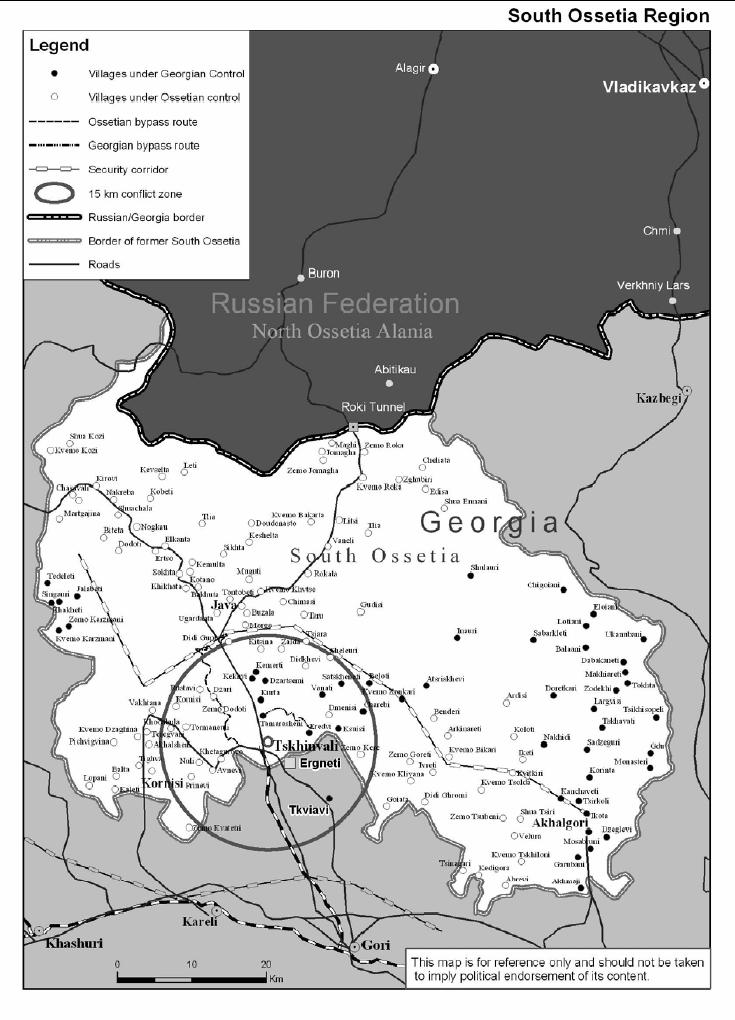
Akhalgori is a small city within the former soviet autonomous republic of South-Ossetia on the territory of Georgia. Until the recent conflict, it was controlled by the Georgian government and mainly inhabited by ethnic Georgians.

Achalgori ist eine kleine Stadt in der einstigen Süd-Ossetischen Autonomen Republik auf der Territorium Georgiens. Bis zum jüngsten Konflikt wurde Achalgori, das überwiegend von ethnischen Georgiern bewohnt wurde, von der georgischen Regierung beherrscht.

In violation of the six-point-plan ratified by the Russian government, Russian troops are now securing South-Ossetian paratroopers in Akhalgori. According to journalists, they have built up two checkpoints south of Akhalgori. Friends of my family staying in Akhalgori reported by telephone, all Georgians willing to stay in Akhalgori must apply for a Russian passport.

Russische Truppen sichern jetzt Süd-Ossetische Verbände in Akhalgori. Dies ist ein Verstoß gegen den Sechs-Punkte-Plan. Nach Berichten von Journalisten wurden südlich von Achalgori zwei Grenzanlagen errichtet. Freunde meiner georgischen Familie, die in Achalgori geblieben sind, berichten, dass sich alle Georgier, die weiterhin in Achalgori leben wollen, russische Pässe ausstellen lassen müssen.

Karte von Achalgori und der Region / A map of Akhalgori and the region
gefunden bei Wikipedia

The ossetian fighters were described to me (from eye-witness) as very uncontrolled. Many of them seem to be drug-adicts.

Die ossetischen Kämpfer wurden mir (von Augenzeugen) als äußerst unbeherrscht beschrieben. Viele stehen offenbar unter Drogeneinfluss.

Weitere Infos über Achalgori bei Wikipedia auf Englisch/ Further info on Akhalgori at wikipedia

Wikipedia states: "The population (of the district of Akhalgori) was primarily Georgian (6,520) and Ossetian (1,110) with good relations between the two communities."

Bei Wikipedia heißt es (übersetzt aus dem Englischen): "Die Bevölkerung (des Distrikts von Achalgori) bestand überwiegend aus Georgiern (6520) und Osseten (1100), wobei beide Volksgruppen gute Beziehungen zueinander pflegten."

The conflict about South-Ossetia isn't primarily an ethnic conflict. There are about 30.000 Ossetians living in Georgia (without South-Ossetia). It is interesting to note that on one hand side South-Ossetia claims independent (with the help of Moscow), one the other hand side people are forced into Russian citizenship.

Der Konflikt um Süd-Ossetien ist und war nicht in erster Linie ein ethnischer Konflikt. In Georgien (ohne Süd-Ossetien) leben etwa 30.000 Osseten. Es ist nicht ohne Ironie, dass sich Süd-Ossetien einerseits (mit der Hilfe Moskaus) für unabhängig erklärt hat, andererseits dort aber russische Pässe verteilt werden.

"Christian Science monitor" (Oct. 6, 2008) cites Georgian citizens who have seen russian forces building a road from Tskhinvali to Akhalgori. According to author Dan Catchpole, they are not going to leave.

Update 8 October: "Georgian Offical says Russian pullout incomplete" by Matt Siegel, Washington Times.

Der "Christian Science monitor" berichtet am 6. Oktober von Georgischen Bürgern aus Akhalgori, die russische Truppen bei der Errichtung einer Straße von Zchinwali nach Achalgori beobachtet haben wollen. Autor Dan Catchpole geht davon aus, dass die Russen dieses Gebiet nicht verlassen wollen.


Dan Catchpole, writing in his blog
Dateline Tbilisi about the future of Geneva talks and Akhalgori (October 16):
"Zeyno Baran, director of the Hudson Institute´s Center for Eurasian Policy in Washington, expects Russia to drag out negotiations.

"If the talks are ongoing, it allows Russia to keep what it has established on the ground. And what they have on the ground benefits them," she said in a telephone interview.

Russia also benefits because the European Union has not responded to the crisis with a unified front.

"Since the war, Germany, France and Italy are all a lot more eager to get back to business as usual, and to see this Georgia business go away," Ms. Baran said. Each country stands to benefit from continuing lucrative bilateral energy and business projects with Russia."

Read the full article (Dateline Tbilisi) here.


If you like this please Link Back to this article...


Georgia-Russia peace talks in Geneva fail

"... EU's special representative for the conflict in Georgia, Pierre Morel, told reporters that “unspecified difficulties” had forced the parties to suspend the talks. New consultations have provisionally been set for 19 November.

However, others at the conference, which was held in Geneva, said the talks collapsed because the Russian delegation refused to participate in a plenary session unless officials from South Ossetia and Abkhazia were allowed in, while Georgia insisted they could only participate in informal working groups on the sidelines of the meeting, which was held in Geneva."

The full article: EuropeanVoice.com


If you like this please Link Back to this article...


Joshua Kucera: "Why Can't We Live Together?"

In a series of reports from former soviet republics, Joshua Kucera reported in May 2008 from South Ossetia, describing the atmosphere in the break-away region of Georgia:

"TSKHINVALI, South Ossetia—The first time I enter Tskhinvali, the capital of South Ossetia, the hotel staff immediately calls the police. They tell me that no one can process my journalist accreditation until Wednesday. It is a Sunday afternoon, and the following Tuesday is the May Day holiday, making it a four-day weekend. Can't I just stay until then and see the town as a tourist, I ask? Nope. So about 20 minutes after I arrive, the police drive me back to the border with Georgia proper and tell me to try again later. I come back on Wednesday and find that the accreditation process consists of writing my name in a book and filling out a small piece of paper that I am told to carry with me everywhere I go. It takes about a minute. I'm visiting South Ossetia as part of a tour across the southern edge of the former Soviet Union, looking at the wildly different directions the newly independent countries have taken since 1991. In the case of South Ossetia, a self-proclaimed independent country that is, in fact, neither independent nor a country, "nowhere" is probably the best way to describe where it's gone. It's perhaps the closest you can get today to experiencing the old Soviet Union, as well as a good place to get the flavor of a good old-fashioned, Cold-War-style proxy war between the United States and Russia..."

Read the whole article on SLATE.

If you like this please Link Back to this article...


Geschosse, gefunden in unserem Wagen / Bullets, found in our car


Is there somebody out there who could give me some information on the type of weapon and bullets? Were the bullets fired from one or two rifles?
Kann mir jemand Informationen geben über die verwendete Waffe und die Patronen? Wurden die Geschosse von einer oder von zwei Waffen abgefeuert?

If you like this please Link Back to this article...


Wer wollte uns töten? Who wanted to kill us?

in short: Probably South-Ossetian civilists. There were about 15 of them blocking the street. The guy who shot at us wore black shirts. Next to him stood a lady in a red dress with a small child on her arms.

in Kürze: Wahrscheinlich Süd-Ossetische Zivilisten. Wir wurden aus einer Gruppe von etwa 15 Personen beschossen. Der Schütze trug schwarze Shorts. Neben ihm stand eine Frau im roten Kleid mit einem Kleinkind auf dem Arm.

Ilja, 4 years old, injured by scattering glas. Three days afterwards.
Ilja, 4 Jahre alt, verletzt durch herumfliegende Glassplitter. Foto drei Tage nach dem Anschlag.

The wounds of my wife, caused by a dum-dum bullet beneath her arm and 5 single scrapnells. There are still about 25 inside her body after the biggest ones were taken out. Photo six days afterwards.
Die Wunden meiner Frau. Unter der Achselhoehle explodierte ein Dum-Dum-Geschoss. Die groesseren Teile wurden in einer Notoperation entfernt, etwa 25 bis 30 kleine befinden sich noch in der Wunde. Fotos vom heutigen Tag, 6 Tage nach dem Anschlag.


A painful wound on the knee. But thanks god, she will be able to move it like before, as her doctors say.
Ein aeussert schmerzhafte Knieverletzung, die aber Gott sei Dank keine Beeintraechtigung der Gelenkfunktion bedeuten wird, wie die Aerzte sagen.


One scrapnell scratched the right wrist. Again, there will probably be no further complications. It hit the hand of my wife just in the moment she pushed our dauther's head down. Otherwise it would have hit the little one's head...
Ein Schrapnell traf das rechte Handgelenk, nachdem meine Frau gerade den Kopf unserer Tochter herunter gedrueckte hatte. Dieser Splitter waere sonst in den Kopf des Kindes eingedrungen. Die Hand laesst sich in gewohnter Weise bewegen, schmerzt aber - wie alle Wunden.


Sopiko, 4 years old, no physical injuries. Three days afterwards.
Sopiko, 4 Jahre, koerperlich unversehrt. Drei Tage nach dem Anschlag.


My back, 6 days afterwards. I was lucky I was able to bend out of the door and as low as possible. This was the moment I got shoot. Six days afterwards.
Mein Ruecken. Am 6. Tag nach dem Anschlag. Ich habe mich glücklicherweise sehr tief aus der Tür hängen lassen. In diesem Moment wurde ich getroffen.

One scrapnell of about 6 mm in diameter as well as 3-4 less in the size of lentils or smaller hit my lungs and are still inside. If I had bent out just an instant later, my spine would have been hit.

Ein Schrapnell von ca. 6mm Durchmesser sowie 3-4 von etwa Linsengroesse befinden sich in meiner Lunge. Haette ich mich einen winzigen Moment spaeter niedergebeugt, waere meine Wirbelsaeule getroffen worden.

The bloody face of Ilja, fotographed by British reporters in front of the first-aid clinic in Gori, became one of the faces of this war. Protesting Georgians held up enlargements in front of the russian embassy in Washington.
Iljas blutueberstroemtes Gesicht, fotografiert von britischen Reportern vor der Notaufnahme in Gori, wurde zu einem Gesicht des Krieges. Vor der russischen Botschaft in Washington protestierende Georgier hielten das Bild in Vergroesserung in ihren Händen.

Here's a link to an interview (in German):
Hier ist ein Link zum Interview auf RTL:

Interview

If you like this please Link Back to this article...


Rückblick: Proteste in Tbilissi am / Looking back to the protest rallye in Tbilisi on 8.8.08

I took these pictures at a protest rallye at Tshavtshavadze-street around midnight (8th to 9th august). It had been a hot day, as I remember, and so were the feelings of the crowd. It was a cheerfull row of some hundreds, marching from the russian embassy (or, as one demonstrator put it, "the devil's embassy") to Tavis suplevis moidani, that is Freedom square.

Ich habe diese Bilder auf dem Protestmarsch auf der Tschawtschawadse aufgenommen, etwa gegen Mitternacht vom 8. auf den 9. August. Es war ein heißer Tag, und so waren auch die Gefühle der Teilnehmer. Der Marsch zog sich hin von der russischen Botschaft (der Botschaft des Teufels, wie sich ein junger Mann ausdrückte) zum Tawis suplebis moidani, also dem Freiheitsplatz.

The blowing of horns almost blasted my ears away.
Das Gehupe der Autos war ohrenbetäubend.


I had very mixed feelings. About war itself. But even more about the outcome. It seemed to me, as if a large number of participants actually believed, the sacking of Tschinvali meant victory. I couldn't believe this naivity, as it was clear, the tiny georgian army could never win over russian forces.

Ich hatte sehr gemischte Gefühle. Über den Krieg selbst natürlich. Aber noch mehr über das drohende Ende. Mir schien, dass ein großer Teil der Demonstanten tatsächlich schon glaubte den Krieg mit der Einnahme Tschinwalis (spricht man Ts - chin - wali) gewonnen zu haben. Eine unglaubliche Naivität angesichts der erdrückenden Übermacht der russischen Armee.


As you can see from this picture, a woman holding up religious votiv tablets expressed her ethnic belonging. (Beeing georgian implicates to many Georgian firstly speeking Georgian and secondly membership in the Georgian Orthodox Church. There are muslim Georgians in the South-West, the autonomous region of Adjara. But that's a different story.)

Diese Frau hält Votivtäfelchen hoch und zeigt damit ihre Solidarität mit der gesamten Georgischen Nation. Sprache und Mitgliedschaft in der Georgischen Orthodoxen Kirche sind geradezu konstitutiv für die georgische Nationalität. (Es gibt im Südwesten, an der Grenze zur Türkei, allerdings auch muslimische Georgier. Aber das ist eine andere Geschichte.)

Of course it was quite a crowd of people gathering for this protest march. But if you take 1,5 million inhabitants of Tbilisi into account, they weren't that many. These believers stayed off the buzz. Patriarch Ilja II. prayed, it was the next day, if I remember correctly, for peace and unity. That was an interesting combination in face of this conflict!
Es nahmen zwar sicher absolut gesehen viele Menschen ander Demonstration teil, angesichts der 1,5 Millionen Einwohner Tbilissis war die Zahl jedoch aus meiner Sicht nicht beeindruckend. Diese Gläubigen hielten sich fern und beteten. Patriarch Ilja II. sprach in seiner Andacht (ich meine am nächsten Tag) eine Fürbitte für Einheit und Frieden. Was für eine interessante Kombination angesichts des Konflikts!

If you like this please Link Back to this article...