Showing posts with label Tskhinvali. Show all posts

Truso-valley / Truso-Tal


Tensions between Georgia, Russia and self-declared South-Ossetia are running high. Now Kokoity claims the Trusso-valley for South Ossetia. Perhaps the incident Moscow is looking for - another provocation, while russian military continues to build up (not only) in the Akhalgori-region and vows to protect russian citizens.

The truso-valley opens up to the main road connecting Kasbegi with Tbilisi and runs north-east of South-Ossetia. It is therefore of strategic interest. If Kokoity`s militiamen enter the Trusso-valley, Russia might speak of a legitimate cause. (The same, by the way, that made them keep Akhalgori, breaking the six-points-ceasefire-plan). Then, if Saakashvili reacts with force, he fulfills Putin´s desire. If he doesn´t, he becomes a lame duck.

After a few kilometers, which you can still make with a normal car, you reach Okrakana. To go further, you need a good jeep.


Okrakana comprises just half a dozen houses. The valley becomes very narrow (follow the path to the left).


River Terek running through the gorge - the "middle section" of the valley


A wishing-tree. Georgians and Ossetians both pray to St. George.


a horse-rider of unknown origin passing by


After the gorge, the valley opens up again. Note the sedimentary rocks to the left.


Looking back in the direction of the gorge. Detail of sedimentary rocks. There are numerous springs with different waters; apparently, there is also a poisonous one on the other side of the Terek.


The high mountains to the left (SSW) mark, since 2008, the de-facto border to South-Ossetia.


Village of Kertisi. There are very few settlements in Trusso-valley. Many of the houses were in fact abandoned (in 2005).


an Azeri (!) sheperd with his wife
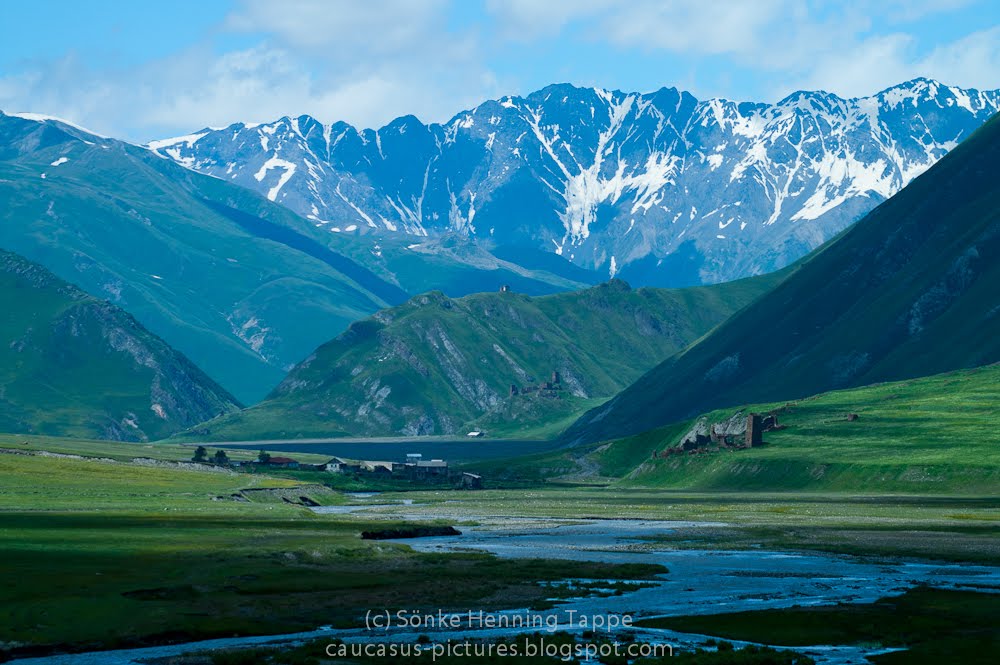

Village of Kertisi. The mountains in the back (about West) mark the border with Russia.


Unconstrained, Russia Eys More Georgian Territories

September 29, 2009

by Giorgi Kvelashvili


"... One year after its military aggression against Georgia, Russia, is apparently trying to not only secure the already impressive territorial gains it has made but to explore the feasibility of more expansion. As was the recent case with navigation in Georgia’s territorial waters along the Abkhazia coast, local adjutants’ claims nearly always precede Russian “concrete” and “decisive” measures, all in the absence of unequivocal international condemnation of the Russian moves.

Arguably, an occupation and annexation of the Truso Valley, let alone of the entire Kazbegi district, is more difficult to justify than the naval control of Georgia’s Abkhazia coast, but given the all-powerful “ethnic” and “humanitarian” nature of the “problem” – as portrayed by the Kremlin – in the Kazbegi district, it would not be impossible for the Russians “to come to the rescue of ethnic Ossetians” once again.

Russia is apparently creating advantageous international conditions to overthrow the pro-Western Saakashvili government in order to complete the process of Georgia’s disintegration."

Full text: GeorgianDaily

If you like this please Link Back to this article...


Pavel Felgenhauer: Russia plans to occupy Georgia

Plan of Georgian occupation is worked out in the Kremlin, according to which Russian military forces will enter Tbilisi from Tskhinvali and Akhalgori and occupy North part of the city. Russian military expert Pavel Felgenhauer stated about it in interview to the paper ‘Kviris Palitra’. According to his information, the second military campaign will start with minor incident, while Russian soldier dies and it will be used as reason by Moscow to start war against Georgia.

Pavel Felgenhauer is a regular correspondent and columnist to "Novaya Gazeta". (The same newspaper, that Anna Politkovskaya worked for.) Read the full article about the Kremlin's plan on InterpressNews.


If you like this please Link Back to this article...


Former Putin advisor says: "President Saakashvili's decision to move against Tskhinvali "was self-defense, though it was quite a risky self defence"

"Currently a senior fellow with the Washington-based Cato Institute, [Andrei Illarionov ] Putin's former senior economic advisor in 2000-2005 said that contrary to how it is being portrayed, the conflict did not begin on 7 August 2008, but was carefully planned and built up since the spring of 2004, when the Russian authorities started supplying South Ossetia and Abkhazia with military equipment and training their military forces, building military bases and strategic highways and railroads.

"The build up culminated with the amassing of 80,000 regular troops and paramilitaries close to the Georgian border, at least 60,000 of which participated in the August war," he explained.

"On 7 August it is estimated that 20,000 to 25,000 Ossetian and Russian troops and 240 tanks were in South Ossetia," he said, adding that the Georgian army has altogether 29,000 troops and 200 tanks, with the main part being stationed to the west facing Abkhazia.

"In the proximity of South Ossetia there were perhaps only 4,000 to 5,000 troops and 42 Georgian tanks," Mr Illarionov said, reminding that president Mikhail Saakashvili declared unilateral ceasefire on 7 August, only to see unprecedented shelling of the Georgian villages in South Ossetia that night.

"All of a sudden they understood that if the Ossetian-Russian troops move, it could be a matter of hours for them to get to Tbilisi."

President Saakashvili's decision to move against Tskhinvali "was self-defense, though it was quite a risky self defence," Mr Illarionov said.

"Saakashvili had received a very clear signal from the West - that America and Europe would not help. Even if the US would have decided to help, it was completely unrealistic, because it would have taken at least two weeks to deploy the very first troops. And it was very clear that 2 weeks was too late to defend Georgia. That is why he took this decision, clearly understanding that he would be left alone in front of Russia," he explained."

Read the full article on EUobserver.


If you like this please Link Back to this article...


Joshua Kucera: "Why Can't We Live Together?"

In a series of reports from former soviet republics, Joshua Kucera reported in May 2008 from South Ossetia, describing the atmosphere in the break-away region of Georgia:

"TSKHINVALI, South Ossetia—The first time I enter Tskhinvali, the capital of South Ossetia, the hotel staff immediately calls the police. They tell me that no one can process my journalist accreditation until Wednesday. It is a Sunday afternoon, and the following Tuesday is the May Day holiday, making it a four-day weekend. Can't I just stay until then and see the town as a tourist, I ask? Nope. So about 20 minutes after I arrive, the police drive me back to the border with Georgia proper and tell me to try again later. I come back on Wednesday and find that the accreditation process consists of writing my name in a book and filling out a small piece of paper that I am told to carry with me everywhere I go. It takes about a minute. I'm visiting South Ossetia as part of a tour across the southern edge of the former Soviet Union, looking at the wildly different directions the newly independent countries have taken since 1991. In the case of South Ossetia, a self-proclaimed independent country that is, in fact, neither independent nor a country, "nowhere" is probably the best way to describe where it's gone. It's perhaps the closest you can get today to experiencing the old Soviet Union, as well as a good place to get the flavor of a good old-fashioned, Cold-War-style proxy war between the United States and Russia..."

Read the whole article on SLATE.

If you like this please Link Back to this article...


Reuters: "Russland lässt OSZE-Beobachter in Zone um Südossetien gewähren"


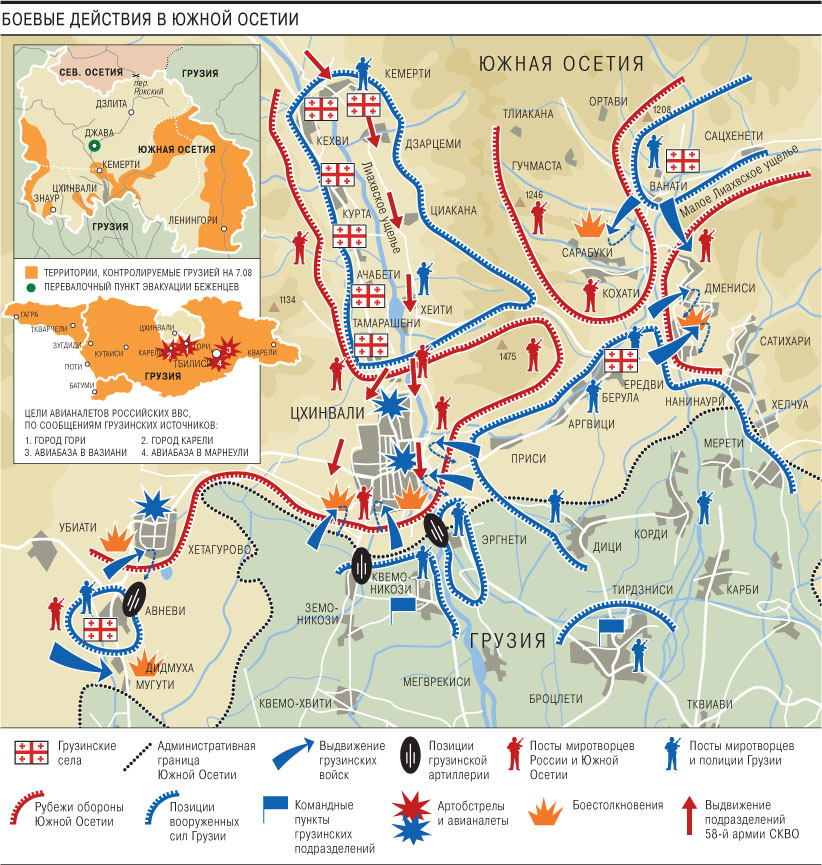
Above you see a chart by UNOMIG, showing damages to Tskhinvali and the villages north on 19th August. The majority of inhabitants of these villages were Georgians. The damages shown were caused by artillery, bombardments and / or lootings.

See Georgiennachrichten: "Russische Besatzungstruppen in Georgien behindern Diplomaten der OSZE"

The article states that special representative Goran Lennmarker was not given access to the georgian villages within South Ossetia, just like the french ambassador to Georgia as well as other representatives of the OSCE before. According to eye-witnesses, lootings go on under protection of the russian military.

Update: Today, Reuters deliver news that OSCE has been given unlimited access in the buffer zone.

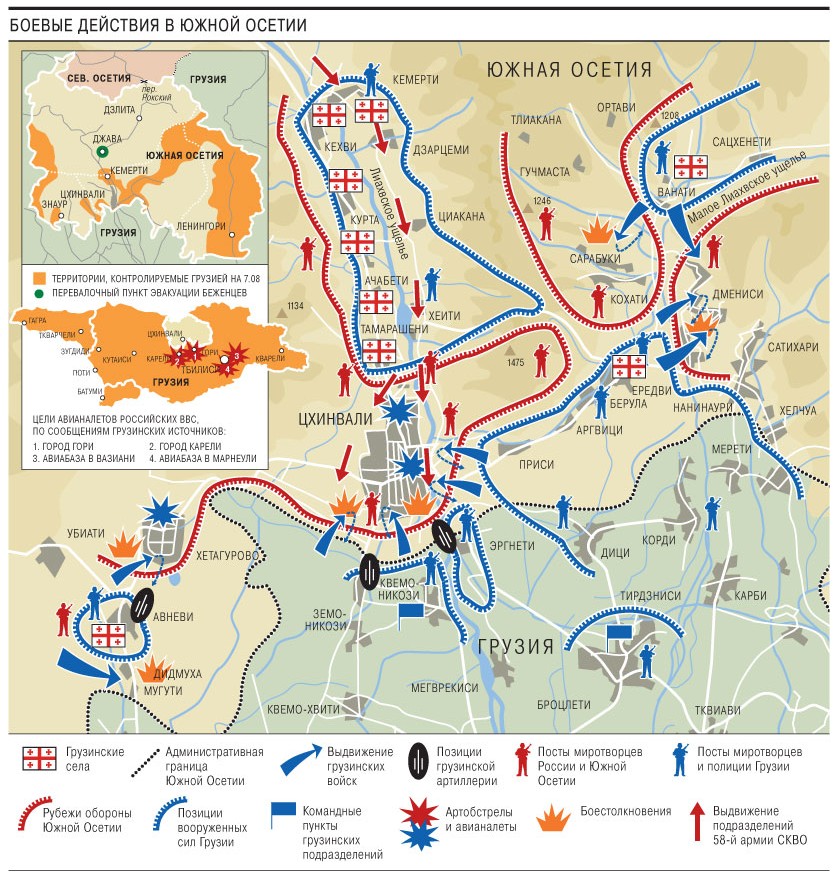
A russian map about the South-Ossetian conflict can be found here: Komersant and uddebatt. Most interesting is the little map in the upper left corner. The orange marked areas were regions with a majority of Georgians. In the south-east corner of the district of South-Ossetia or Shida kartli by georgian name, you will find the russian name "Leningori" for what is in Georgia, since the fall of communism, again called "Achalgori" (meaning "new Gori"). This is where the datcha of my parents in law stands; my wife will probably never see the house of her beloved grandmother again, where she spent all summers. When she was a child, children of georgian and ossetian origin played together. The sister of my father in law, who together with her husband and relatives spent three days and nights in the woods fearing ossetian paratroopers, might never see her house again, which is located a few miles up north, not far from Ikoti.

It is interesting to notice that russian military blocks the road to Akhalgori, stands in Poti, still holds Senaki and Zugdidi and so on, while on the other hand side the russian government signed the six points for withdrawl. On 27th August, Russian foreign minister claimed that Russia was "in full compliance" with the peace deal.

Uddebatt also shows this interesting map. This is what the Russians understand as their "peace zone". Just follow the road from Gori to the west and you´ll see the russian controlled zone just right to the north of the main route from west Georgia to east Georgia. Furthermore, take into account that the Russians still occupy Poti and Zugdidi (and, as reports from journalists, who´ve been there, aren´t likely to withdraw soon), it becomes clear, what Moscow interprets as peace:

1. Annexation of Abchasia and South-Ossetia as of before this war (calling it "independece")
2. Annexation of those areas of South-Ossetia (or Shida Kartli), that weren´t unter South-Ossetian control before
3. Control over Poti, the port to international commerce
4. Control over Zugdidi, therefore gaining complete control over the north-west of Georgia (region of Svaneti)
5. Control over the east-west highway, the main connection between east and west Georgia.

Meanwhile, german foreign minister Steinmeier, a close intimate with Gerhard Schröder, who now earns his money from Gazprom, still dreams of a common strategic architecture with Russia. Holy simplicity! (Ok, I promise I will never polemize again against Mr. Steinmeier, if he promises never ever to be employed by Gazprom.) I´m sure, the Kremlin´s halls echo long lasting laughters of Putin, Medvedev, Lavrov & Co.


If you like this please Link Back to this article...


Georgian Tank near Gori / Georgischer Panzer nahe Gori


If you like this please Link Back to this article...