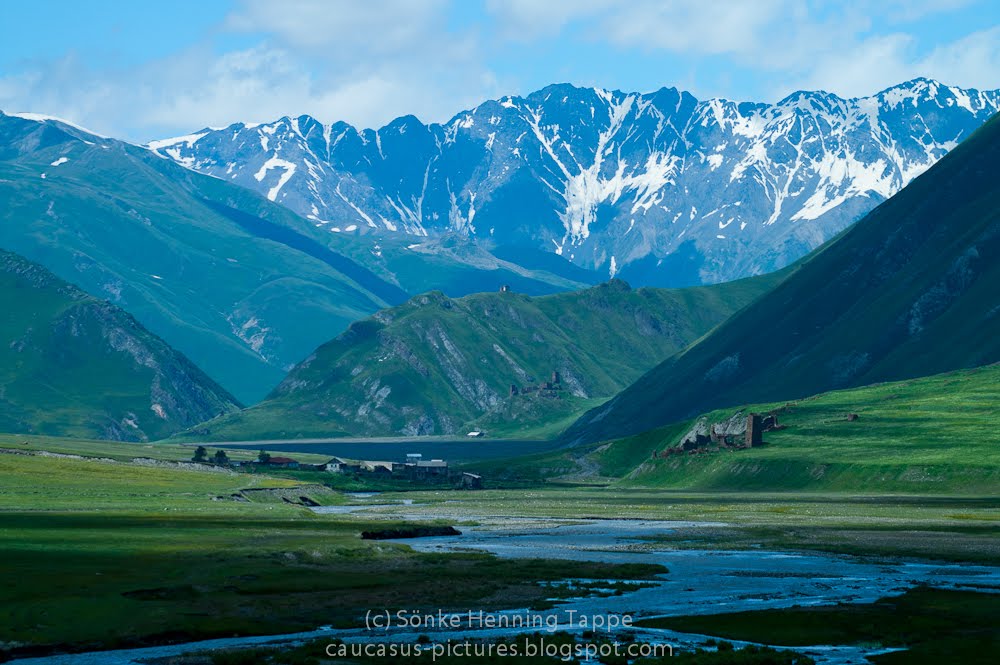
Showing posts with label Russia. Show all posts

Russia is starting large-scale evacuation from occupied Georgian regions

Russia is starting large-scale evacuation from occupied Georgian regions By Namotam | Posted August 2, 2012 | Tskhinvali Women, children and the elderly are being taken out of Tskhinvali, say the residents of Gori Region, which borders with the breakaway South Ossetia...

CNN iReport

If you like this please Link Back to this article...


Mamuka Areshidze: Need to Consider Recognition of Abkhaz Independence

Mamuka Areshidze:

“We have to take extraordinary measures in order to return not Abkhazia, but to return Abkhazians… If we want to return Abkhazians, we should save them,” Areshidze said.
“Return of Abkhazians will be impossible if we leave them in the situation in which they currently are. Russia is vigorously changing demographic landscape of Abkhazia."
He said that Russia’s policy of encouraging its military personnel serving in Abkhazia and their families to stay in the region after end of service would further change the demographic situation by decreasing already diminished share of ethnic Abkhazians.
He said that independence for Abkhazia should not in any way be unconditional and it should be linked to set of preconditions, including return of refugees and internally displaced persons.

“I am not saying that we should directly give Abkhazia independence and put an end on that. We should put forth preconditions in the context of giving independence, for example return of refugees,” Areshidze said and added that by recognizing Abkhaz independence Tbilisi will distance Sokhumi from Moscow.
“That would be the only way for us to speak with the Abkhazians in presence of the international community without Russia,” Areshidze said.

“I want to say one thing: the time of traditional approaches is over. Our adversary, which has very strong political, diplomatic, as well as military resources, outdistances us in every way. So we have to make such a surprise move which will disarm our adversary – that means the move which will distance our adversary from the Abkhazians,” he said.
The case of South Ossetia is different, Areshidze said."


Civil Georgia

If you like this please Link Back to this article...


US uses Tbilisi as a spring ground for a possible attack on Iran'

 http://news.az/articles/georgia/23248 

Alexander Rahr, a German political scientist, stated that in recent weeks Russia achieved incredible success in South Caucasus."It's a brilliant policy,"
...
"Russia's positions were reinforced in recent weeks, not even months," he said.In his view, Moscow's achievements were possible due to somehow passive behavior of the USA. Rahr thinks America sits in Georgia and has no aim to restrain Russia. He added Washington uses Tbilisi as a spring ground for a possible attack on Iran.

If you like this please Link Back to this article...


Russia niggled by Turkmen oil route (The Messenger Online)

BP reported that as of August 16, 2010, Turkmen oil is being transported through Baku-Tbilisi-Ceyhan pipeline. Turkmen oil is transported via tankers to Baku and then pumped into the Baku-Tbilisi-Ceyhan pipeline. This route enables Turkmenistan to bypass Russia to sell its oil to the world markets. Konstantine Simonov, Director of the National Energy Security Foundation in Russia commenting on this fact said that transiting Turkmen oil to Baku-Ceyhan is a slap in Russia’s face, and while it is unpleasant it does not change the overall situation very much. Turkmen oil represents only 5 percent of the Baku-Ceyhan transit capacity, and overall Turkmenistan is not a big oil producing country. It produces five times less oil than Azerbaijan and 8 times less than Kazakhstan. Nevertheless, Simonov thinks it is a very serious warning for Russia. Russia should introduce certain amendments regarding its economic interests and policy towards the Caspian countries, in particular Turkmenistan.

The Messenger Online
, Thursday, August 26

If you like this please Link Back to this article...


Eurasia Review: "Russia's S-300 System: Leveraging With Guns"

EurasiaView comments on the latest Russian arms-sale to Azerbaijan and concludes:

...

What is clear, however, is that Russia’s casual vending and deployment of the S-300 underscores the Kremlin’s desire to create points of stress and leverage in key areas of the world. Consider that the S-300 is now deployed in Syria, Armenia, Abkhazia, and likely soon to be sent to Azerbaijan. Iran is technically due for delivery of the system. In a similar vein, Russia’s wrangling over the French helicopter carrier Mistral deal seems to have broken what once seemed to be a certain sale. Russia appears to be going back on its original exclusive bidder partnership with France and is issuing an open tender, which is sure to attract possible suitors from around the world, including Spain and the Netherlands, which have both expressed interest in the past.

The sticking point is on the transfer of technology, which France has refused to include in the sale as originally agreed. Unexpectedly, Russia changed its requirements mid-stream and demanded the inclusion of full systems, which put the program into deadlock. Russia is now upping the ante by inviting other bidders, demonstrating to France – and its labor unions – that it’s happy to go elsewhere for what it wants. [8] Russia has already sowed the seeds of distrust within NATO over the original Mistral agreement, and now sets to go even further by forcing France to compete with other NATO allies like Spain and the Netherlands; it will be a competition on whom can deliver the most advanced NATO technology to Russia for the cheapest price.

To be sure, the Russian strategy in every case seems to be maximizing its leverage against and between different countries – Iran and Israel, Armenia and Azerbaijan, Georgia and the conflict regions, Western and Eastern Europe, and the like. Though the conflicts vary in scope, size, and geopolitical weight, they all share the commonality of Russian strings somehow attached and, ominously, the threat or the promise of weapons sales.

Read the full article here.

If you like this please Link Back to this article...


Democracy in Tbilisi (by Tedo Japaridze)

The August 2008 war with Russia exacerbated many existing problems in Georgia, perhaps most obviously whether Tbilisi’s priority should be the establishment of a strong state or one with democratic institutions. With Mikheil Saakashvili at the helm, this seems to be an either-or proposition. Although he is talented and well educated, Saakashvili is unwilling to allow the whole of Georgia’s political class to take part in the democratic process. He has suppressed dissent and made little effort to include members of the opposition in practical domestic and foreign-policy decisions, other than in a retouched manner for PR purposes—thus straying from the principles and values of democracy in favor of his own personal political ambitions and interests. And, of course, it seems that the Georgian opposition is disorganized and chaotic.

Few in the West, however, recognize Saakashvili’s true intentions. They either do not know or do not care much, being busy and over-burdened with their own complex and challenging problems. Though this regime is better than the last, there is a lot more talk of change and democratic politics than action. The current government has paid more attention to its international image than with reforming Georgian politics. With the help of foreign lobbyists, Saakashvili successfully created his own narrative about Georgia’s supposed respect for democratic institutions, one eagerly accepted by Western states. This narrative went over particularly well in the United States, where the Bush administration and, after that, presidential candidate John McCain offered steadfast support to Tbilisi. It seems the Obama administration’s position may be little different.

In Western capitals, Georgia was recognized as the “the beacon of democracy” and, to be fully sincere, the Revolutions of the Roses began that way. But this later didn’t reflect the realities on the ground. Georgia remained undemocratic and illiberal. The disconnect between Western perception and Georgian reality was no more evident than in the war with Russia. In the West, the conflict was seen through Saakashvili’s version of events, with Moscow as the aggressor, instead of the truer line of argument—that Saakashvili, being strongly provoked to do so by the Russians, got Georgia involved in the war in a vain attempt to integrate Tbilisi into the Euro-Atlantic community. That strategy did not work. America and Europe did not risk war with Moscow to bail out Georgia. And our problems cannot be solved through Western sympathy alone. So Georgia still remains defeated, dismembered and occupied country.

The way out of Georgia’s post-war crisis lies in ensuring the continued enfranchisement of all citizens of Georgians in the country’s political process. The government must search for compromises and maintain a political balance, since democracy is a constantly renewable contract resting on a country’s institutional systems and legitimacy. Free-and-fair elections, even ones recognized by the international community, are only the beginning of the process. Even undemocratic and illiberal countries are capable of holding fair elections that deserve the approval of both foreign observers and the wider international community. Georgia has been governed by illiberal methods, and the main administrative and financial resources of the country are often directed in the interests of one political clan. Real democratic systems require mutual responsibility between the ruling elite and its citizens, including first of all the opposition. A secure democracy is one that is governed according to its constitution and its laws. Only by striving to fully embody this democratic ideal will Georgia be able to cope with the problems it is facing.

Tbilisi must not look abroad for assistance with its political difficulties—and this includes in its troubles with Russia. The West will not go to war with Moscow over Georgia. The United States is beset with its own domestic and foreign-policy agendas and can ill afford to antagonize the Kremlin over a single Eastern European state. Europe, meanwhile, is beholden to Russian energy supplies and other business and trade interests. Moscow is well aware of the leverage it holds and uses its powerful commercial and political interests to its advantage. Georgia must be very careful not to make hasty decisions that would annoy Russia or anybody else in the world, as it will find little more than a sympathetic ear in the international community, as it belatedly realized in the aftermath of the conflict over Abkhazia and South Ossetia.

So Georgia must first and foremost help itself. It must settle its own internal problems by ensuring its adherence to democratic governance. Georgians must learn from their past mistakes, and realize that Saakashvili’s obsession with his standing in Western capitals will get them nowhere. A commitment to real democratic reform that includes Georgians of all political stripes is the only way out of the country’s current post-war malaise.

Read the whole article at "National Interest online"

If you like this please Link Back to this article...


Unbelievable: French Minister Expects Deal on Warship Sale to Russia

Published: October 1, 2009


Moscow has just recently sent a warship to the Abkhazian coast to counter Georgian attacks on illegal trade with Sukhumi. Now this would be just the right class of ship for that mission, right? Can't believe the French government would be so stupid, or should I?

If you like this please Link Back to this article...


Truso-valley / Truso-Tal


Tensions between Georgia, Russia and self-declared South-Ossetia are running high. Now Kokoity claims the Trusso-valley for South Ossetia. Perhaps the incident Moscow is looking for - another provocation, while russian military continues to build up (not only) in the Akhalgori-region and vows to protect russian citizens.

The truso-valley opens up to the main road connecting Kasbegi with Tbilisi and runs north-east of South-Ossetia. It is therefore of strategic interest. If Kokoity`s militiamen enter the Trusso-valley, Russia might speak of a legitimate cause. (The same, by the way, that made them keep Akhalgori, breaking the six-points-ceasefire-plan). Then, if Saakashvili reacts with force, he fulfills Putin´s desire. If he doesn´t, he becomes a lame duck.

After a few kilometers, which you can still make with a normal car, you reach Okrakana. To go further, you need a good jeep.


Okrakana comprises just half a dozen houses. The valley becomes very narrow (follow the path to the left).


River Terek running through the gorge - the "middle section" of the valley


A wishing-tree. Georgians and Ossetians both pray to St. George.


a horse-rider of unknown origin passing by


After the gorge, the valley opens up again. Note the sedimentary rocks to the left.


Looking back in the direction of the gorge. Detail of sedimentary rocks. There are numerous springs with different waters; apparently, there is also a poisonous one on the other side of the Terek.


The high mountains to the left (SSW) mark, since 2008, the de-facto border to South-Ossetia.


Village of Kertisi. There are very few settlements in Trusso-valley. Many of the houses were in fact abandoned (in 2005).


an Azeri (!) sheperd with his wife


Village of Kertisi. The mountains in the back (about West) mark the border with Russia.


Unconstrained, Russia Eys More Georgian Territories

September 29, 2009

by Giorgi Kvelashvili


"... One year after its military aggression against Georgia, Russia, is apparently trying to not only secure the already impressive territorial gains it has made but to explore the feasibility of more expansion. As was the recent case with navigation in Georgia’s territorial waters along the Abkhazia coast, local adjutants’ claims nearly always precede Russian “concrete” and “decisive” measures, all in the absence of unequivocal international condemnation of the Russian moves.

Arguably, an occupation and annexation of the Truso Valley, let alone of the entire Kazbegi district, is more difficult to justify than the naval control of Georgia’s Abkhazia coast, but given the all-powerful “ethnic” and “humanitarian” nature of the “problem” – as portrayed by the Kremlin – in the Kazbegi district, it would not be impossible for the Russians “to come to the rescue of ethnic Ossetians” once again.

Russia is apparently creating advantageous international conditions to overthrow the pro-Western Saakashvili government in order to complete the process of Georgia’s disintegration."

Full text: GeorgianDaily

If you like this please Link Back to this article...


Paul Rimple:: Signifying mud

One year after the Russia-Georgia war and the scum is still floating on the top. In some cases, it is still rising.
...
The equation was simple. If Bush’s foreign policy was bad, then Saakashvili was bad. Therefore, his enemy Putin must be good. The man that leveled Grozny during his dirty war with Chechnya had suddenly become a victim of the Cheney doctrine. Blah blah blah.

I have friends in Armenia and Abkhazia that really believe the US masterminded the war, based on Russia’s successful propaganda machine and the logic that the US wouldn’t have armed and trained Georgia otherwise. The US can be blamed for lots of things but not for instigating or taking part in last August’s war. The US had repeatedly told Saakashvili to mellow out on the war drum stuff. Renewed conflict would only crush Bush’s big plan to get Georgia into NATO, which it ultimately did.

People also believe that Georgian troops were doped to kill civilians, as that is what the headlines said. The Moscow Bureau for Human Rights (MBHR) interviewed witnesses who claimed that captured Georgian troops had needle marks in their arms. Think about it. Georgian commanders handing out fixes of heroin to their men to help them run over babies in tanks and shoot grandmothers. The logic is compelling.

And as I have mentioned before, people are still stuck on the number of 2000 civilian deaths in Tskhinvali, a number that was accepted before the smoke cleared in the de facto South Ossetian capital, only two days after the August 8th attack. Later, the number fluctuated between 1400-2100, depending on who was reporting. Numbers are good for news. Even Reuters fell for it. It was too late when head of the Russian Prosecutor-General’s investigative committee, Alexander Bastyrkinet, came out with the official civilian death toll of 162 on Christmas 2008. Yet the number is enough for South Ossetia and Russia to claim “genocide” with a straight face, while marauders amped up on the conviction of 2000 deaths systematically destroyed Georgian villages, by flame and bulldozer, displacing tens of thousands people from their homes.

And today, because the Ukraine isn’t playing ball on Russia’s terms, the country has become implicated in the South Ossetia war. Mud flinging is free and easy when the state controls the media and Russia well knows that mud sticks, if you throw enough of it, often enough.

Find the full article here.

If you like this please Link Back to this article...


Arms race in the Caucasus (Georgian-Russian Conflict)

Abchazia + South Ossetia / Russian Federation:

"Russland hat laut seinem Nato-Botschafter Dmitri Rogosin das Recht, Abchasien und Südossetien bei Bedarf mit Waffen zu versorgen, damit sich diese vor erneuten Aggressionen schützen können."

(Translation:)
"Russia has the right to supply arms to Abkhazia and South Ossetia, if needed, says Dmitri Rogosin, Russian envoy to NATO. They must be able to defend themselves from renewed hostilities." Full text at RIA Novosti

Truth is, most of the (modern) weaponry will go to the russian military bases there.

Georgia / USA:

Philip J. Crowley, assistant secretary of state, said at a press briefing in Washington on July 23:
...
"Asked if the United States were “contemplating rearming Georgia” Crowley responded: “Georgia is on a path that the United States supports towards NATO membership. Clearly, a fundamental tenant of NATO membership is to have a military that meets NATO standards and would add to the capability of the alliance. So it is logical that the United States would have a military-to-military relationship with Georgia.” Full text at CivilGeorgia

(In fact, most arms come from the Ukraine, some from Israel. The US want to focus on military training, but don´t excluse arms-delivery in the future.)

It is interesting to note that provocations from both sides go on. Examples of the last week: Saakashvili openly hails Lukashenko´s maneuver against Moscow, urging who? to take the road to Sukhumi or Tskhinvali via Georgia proper. (Europe´s last dictator should know better: The roads from Georgia proper to Sukhumi and Tskhinvali are closed for foreigners.)
The russian government continues to launch anti-georgian propaganda. Rogosin mocks NATO and Georgia alike that there were only two choices for Georgia to achievie NATO membership: Accepting the de-facto borders or admitting Abchazia, South Ossetia and russian army bases alike into NATO. Furthermore, Moscow wants to know that the georgian governement plans manifestations on the de-facto border to South Ossetia or even a march into Tskhinvali. In this sweet story, RIA Novosti quotes US Secretary of State Joe Biden telling Michael Saakashvili to listen to his mother´s advice, just as he would listen to his 92-year-old mum himself. Well, you get the idea. (Interestingly, there seems to be no english version.) Finally, Russia is boasting about military advantages over its opponent. It seems as if the russian government desperately stems against the last remaining super-power just for a matter of principle: The more danger, the more honour.

If you like this please Link Back to this article...


A next Russian-Georgian war end of July/beginning of August?

Wu Wei refers to an article of the Moscow times and throws in the planned visit of US vice president Joe Biden between July 22 and 24.

"After that there's a clear run for Putin unless Sarkozy has any plans to visit as well."

Read the full article(s) here.

If you like this please Link Back to this article...


Paul Goble: Russian Experts Divided on Probability of New War with Georgia


As Moscow continues a military exercise in the North Caucasus that it says is designed to prevent conflicts, one leading Russian expert says that the probability of a new war between Russia and Georgia may be as high as 80 percent, while another suggests that such predictions themselves constitute “a dangerous provocation.
...
“In the government of Russia, there are no idiots ready to take such steps,” he says, and he offers three reasons for that. First, there are the upcoming negotiations with US President Barak Obama about strategic nuclear weapons, talks which are “important to Russia” and which the outbreak of a conflict could threaten.

Sergey Markedonov, a leading Russian specialist on the Caucasus:
Suppose for a minute that as these talks are going on, “a war with Georgia” breaks out. “What do you think Obama would do? It is not excluded that he would break off the talks and leave,” not an outcome that the Moscow leadership or the American leadership for that matter would be very happy about.
Second, Markedonov argues that “after the recognition of Abkhazia and South Ossetia, Russia is not at all interested in a new escalation of the conflict.” It has its forces and regimes where it wants them. And “if there had been a desire to occupy Tbilisi, this would already have been done in August of last year.”
And third, he points out, “it is necessary to understand that any politician who comes to power after [Georgian President Mikhiel] Saakashvili be it [Irakli] Alasania or [Nino] Burjanadze will not be pro-Russian. And that will be even more true if this [change in Tbilisi] occurs in the course of military actions.
At the same time, Markedonov insists, Georgia too “cannot be interested in a war now” because “many of the illusions [its leadership had last year] have already been dispelled, since the situation now is far from the most favorable.” First of all, Saakashvili “does not have the sympathy of the West” that he did.
Second, “Georgia’s strategic positions are much worse than they were a year ago,” even if one considers that only from the point of view of geography. And third, Georgia, which has received negative comments from European institutions in the past for last year’s conflict, would receive even more negative ones if it appeared that Tbilisi had in any way triggered a new war.
But Markedonov says that the biggest mistake those who predicting a new conflict on the basis of the ongoing maneuvers are making is to assume that the war last year was a rapid reaction “to the events of August 7-8.” In fact, last year’s war was, in Markedonov’s view, “the result of a four-year-long policy of Georgia” and Moscow’s plans to counter it.

Pavel Felgenhauer:
... the probability of a new war is “quite high, from 50 to 80 percent,” with the conflict most likely to begin “in the middle of July ..."
...
First, Moscow’s military maneuvers in the region have grown larger and have become more focused on Georgia than in the past. Second, Georgia can be counted on to do something that Moscow can point to as a provocation.
These Georgian actions may be no more than German claims that the Poles attacked the Germans in 1939 or Soviet suggestions in the same year that the Finns fired on the territory of the USSR. But a similar claim about Georgia will be sufficient not only to allow Moscow to act but to explain its actions to others.
And third, Felgengauer notes, there is an important difference between 2008 and 2009. “In August of last year, Georgia was not planning to fight with Russia; it had prepared for war with the separatists and therefore it suffered complete defeat. Now it is preparing for a war with Russia,” a conflict it cannot win but one that might draw in others on its side.
But the Moscow writer’s clinching argument from his point of view appears to be this: Moscow was able to fight a war last year without being punished or even all that seriously condemned by the international community, and thus Russian leaders thus have concluded that they can engage in a new war at little or no cost.

Read the full article on Georgian Daily.

If you like this please Link Back to this article...


Save Georgia’s Peace Mission

...

Now, Moscow has taken aim at the only major international organisation with a solid track record in Georgia, the 56-member Organization for Security and Cooperation in Europe (OSCE). The OSCE has been in Georgia for more than 15 years: monitoring unstable areas in and around South Ossetia, promoting conflict resolution, supporting minority issues, helping lay the foundations for democracy and the rule of law, and criticizing electoral fraud. In South Ossetia it even facilitated economic rehabilitation projects between ethnic Georgians and Ossetians until the August war.

Last Month, OSCE member states met in Vienna to work on a Greek-sponsored compromise to keep the OSCE in Georgia, one of the final steps in thorny negotiations which have been going on since January. But Moscow shot down the Greek proposal, which had already been heavily amended to try to address Russian concerns, by preventing it from coming up for a vote.

There are several possible reasons why Russia wants the OSCE out of Georgia, one of the Organization's biggest and most important missions.

Moscow could be reluctant for the world to see what has gone on inside South Ossetia under its eight-month military "liberation" activities.

Russia's huge military might did not prevent South Ossetian militias from driving about 25,000 ethnic Georgians from their homes. In many cases local militias burned, looted, and even bulldozed villages as Russian troops stood by, in actions that Human Rights Watch has called "crimes against humanity" and the Parliamentary Assembly of the Council of Europe termed "ethnic cleansing".

By closing the OSCE in Georgia, Russia also adds another front in its long-term diplomatic endeavour to undermine the efficiency of the OSCE as a whole. Since 1975, the Organization has helped promote European peace and security. But for years now, Moscow has been unhappy with the group's focus on human rights, media freedom and fair elections as the best way to encourage stability. Russia has used the political tools available to it as a member state to delay and obstruct the Organization's smooth functioning. Moscow has, for example, repeatedly delayed the passage of the OSCE's annual budget.

...

Read the full article on Reuters.

If you like this please Link Back to this article...


TBILISI BEING FORTIFIED FOR "POSSIBLE" MILITARY STRIKE


GEORGIA: TBILISI BEING FORTIFIED FOR "POSSIBLE" MILITARY STRIKE -- REPORT
6/05/09

Defensive fortifications are being set up around Tbilisi in anticipation of a possible military strike on the Georgian capital, according to a Georgian media report.

Rezonansi, an opposition-minded daily, claimed that in addition to Tbilisi, fortifications are being built near the administrative border with the breakaway region of Abkhazia, where Russia has troops stationed. Defense Ministry officials were not available to confirm or to deny the June 4 report.

In interviews with the paper, independent military experts stated that defense measures are being taken to protect Tbilisi. "This step is correct and logical because occupying troops are stationed just a few kilometers away from the capital..."

Read the full article on EurasiaNet.

If you like this please Link Back to this article...


Onnik Krikorian: "Nationalists agitate for Samtskhe-Javakheti"

"Following the arrest of two ethnic Armenians in the Samtskhe-Javakheti region of the Republic of Georgia, nationalist groups in Armenia plan to hold a demonstration outside the Georgian Embassy in Yerevan on Wednesday. While it is unlikely to be well attended, the activity of such nationalist groups has sharply increased since the short war between Georgia and Russia last August. Chances are that this is no coincidence.
Having openly considered the possibility to use the short conflict over South Ossetia to push for separation from Georgia, nationalist think tanks and analytical centers make no secret of their desire to frustrate good relations with Armenia's neighbor and are more noticeable than ever before. "


Onnik Krikorian is a freelance photojournalist and writer from the United Kingdom based in Yerevan, Armenia.

Read the full article on Frontline.


Poster on the way to Garni temple, national monument and important tourist attraction. The map is titled: Colchide, Iberie et albanie. Kolchis refers to the ancient name of West Georgia, known to the Greeks (Golden Vleece, Prometheus), Albania roughly to present Dagestan and Azerbaijan, Iberie to Armenia and most eastern parts of Georgia.

English Wikipedia explains the term "Iberia":
The theme of Iberia (Greek: θέμα 'Ιβηρίας) was an administrative and military unit – theme – within the Byzantine Empire carved by the Byzantine Emperors out of several Armenian and Georgian lands in the eleventh century. It was formed as a result of Emperor Basil II’s annexation of a portion of the Georgian Bagratid domains (1000-1021) and later aggrandized at the expense of several Armenian kingdoms acquired by the Byzantines in a piecemeal fashion in the course of the eleventh century. The population of the theme was multiethnic with the Armenian majority, including a sizable Armenian community of Chalcedonic rite to which the contemporary Byzantines expanded, as a denominational name, the ethnonym "Iberian", a Graeco-Roman designation of Georgians. The theme ceased to exist in 1074 AD as a result of the Seljuk invasions." (Link to Wikipedia)


If you like this please Link Back to this article...


Pavel Felgenhauer: Russia plans to occupy Georgia

Plan of Georgian occupation is worked out in the Kremlin, according to which Russian military forces will enter Tbilisi from Tskhinvali and Akhalgori and occupy North part of the city. Russian military expert Pavel Felgenhauer stated about it in interview to the paper ‘Kviris Palitra’. According to his information, the second military campaign will start with minor incident, while Russian soldier dies and it will be used as reason by Moscow to start war against Georgia.

Pavel Felgenhauer is a regular correspondent and columnist to "Novaya Gazeta". (The same newspaper, that Anna Politkovskaya worked for.) Read the full article about the Kremlin's plan on InterpressNews.


If you like this please Link Back to this article...


Pavel Felgenhauer: "Russia's Coming War with Georgia" and my own thoughts...

...

"South Ossetia, isolated and with its "independence" unrecognized by the international community, is in crisis. This may explain the constant bellicose statements coming from Tskhinvali: renewed military confrontation may seem the only way to end the unacceptable status quo, established by the August 12 ceasefire.

The belligerence of the separatists is actively supported by Moscow, which has its own reasons to detest the status quo. The Russian Foreign Minister Sergei Lavrov announced, "Russia is concerned about Georgian troop concentrations near the borders of South Ossetia and Abkhazia" (RIA-Novosti, January 16). EU assurances that there is no "troop concentration" are not accepted. This week the Russian permanent representative in the OSCE, Anvar Azimov, announced, "The Georgians are concentrating troops and heavy weapons, building new bases and checkpoints." Azimov accused the EU observers of impotence and illegally trying to move their operations into Abkhazia and South Ossetia (RIA-Novosti, February 11).

The ceasefire last August has left the strategically important Russian base in Armenia cut off with no overland military transit connections. The number of Russian soldiers in Armenia is limited to some 4000, but during 2006 and 2007 large amounts of heavy weapons and supplies were moved in under an agreement with Tbilisi from bases in Batumi and Akhalkalaki (Georgia). At present there are some 200 Russian tanks, over 300 combat armored vehicles, 250 heavy guns and lots of other military equipment in Armenia - enough to fully arm a battle force of over 20,000 (Nezavisimoye Voyennoye Obozrenie, August 20, 2004). Forces in Armenia can be swiftly expanded by bringing in manpower by air transport from Russia. Spares to maintain the armaments may also be shipped in by air, but if a credible overland military transit link is not established within a year or two, there will be no possibility to either replace or modernize equipment. The forces will consequently degrade, undermining Russia's commitment to defend its ally Armenia and Moscow's ambition to reestablish its dominance in the South Caucasus.

...

While snow covers the Caucasian mountain passes until May, a renewed war with Georgia is impossible. There is hope in Moscow that the Georgian opposition may still overthrow Mikheil Saakashvili's regime or that the Obama administration will somehow remove him. However, if by May, Saakashvili remains in power, a military push by Russia to oust him may be seriously contemplated. The constant ceasefire violations could escalate to involve Russian servicemen - constituting a public casus belli. The desire by the West to "reset" relations with Moscow, putting the Georgia issue aside, may be interpreted as a tacit recognition of Russia's right to use military force."

Read the full article at Jamestown Foundation.

Also read: Russia plans joint air-defense with Armenia (in German on RIA Novosti)

It's interesting to think further ahead. What if Georgia fell under the Kremlin's supremacy again? At least Abkhazia might very well try to gain true independence. (Remember the last elections, when Moscow's candidate was defeated?) For this case, they just established an air base in Abkhazia. The aim is not only to defend the Kremlin's interest in the South Caucasus region (mainly against Georgia), but also their stronghold in Abkhazia itself. This, too, explains why the Russian military has no interest in a peaceful settlement of the present conflicts around the two separatist regions of Georgia. Without the Abkhaz-Georgian antagonism, Sukhumi might rethink it's relationship with Moscow. (Among the population of Abkhazia, Russians are not as beloved as the official press tries to show us. Just think of the Olympic games at near-by Sotchi and astronomically rising real-estate prices in the northern cities of Abkhazia including Sukhumi and you get the picture.)

See also here and here.

South-Ossetia, although poor, is still the biggest trump card in the hands of Putin and Medvedev. Firstly, because Russian tanks are stationed now only about 45 kilometers from Georgia's capital. Secondly, because South-Ossetia looks south to Georgia's weakest strategic point, that is the rather narrow East-West-connection (the "highway" running from Tbilisi to Batumi). Thirdly, continuing violations of the ceasefire-agreement create pressure on Saakashvili's government and an athmosphere of instability and unsureness, deterring investors and thwarting Georgia's ambitions on NATO-membership. And eventually, there is another option: By "proving" that an independent South-Ossetia could not defend itself against "aggressive" Georgia, it can graciously be admitted into the Russian Federation in a year or two.

The reference to Armenia and Russian troops stationed in Armenia might also give a clou to the (indirect) support of the Javakheti-movement of Armenians in Georgia, pressing for autonomy. Recent history has shown what "autonomy" for Georgia really means - the destruction of a multi-ethnic state, while on the other hand side the war against "bandits" and separatism in Chechnyia and elsewhere in the North Caucasus continues, accepted by the West as a "fight against terrorism" after 9/11.

What next will be accepted by the West, falsely assuming "common interests" with Putin and his camarilla?

If you like this please Link Back to this article...


Ariel Cohen: Russia regains key air base to project power in Caucasus

This is the largest military airfield in the southern Caucasus, boasting a runway that is 4 kilometers long. The runway ends less than 100 meters from the sea, allowing aircraft to take off at very low altitudes over the sea and proceed undetected by enemy radar in the initial phases of flight.

In the Soviet times, Gudauta -- Bombora -- air base could accommodate all types of military aircraft, including fighter jets, close air support and heavy military transport. The air base used to host a separate paratroops regiment and was among the first air bases to receive the Soviet Sukhoi Su-27 fighter jets (NATO designation Flanker). Sukhoi fighters also operated out of Bombora against Georgian attack aircraft and helicopters
in the 1992-1993 Georgian-Abkhaz war. At that time, the Russian military ran the base.

In 1999, acting upon Georgia's demands, Moscow committed to withdrawing from the Gudauta base. In 2001 it declared that it had done so -- a claim Tbilisi has contested continually. According to Gazeta.ru, the Abkhazian Ministry of Foreign Affairs has indirectly confirmed the presence of Russian aircraft in Gudauta after the alleged withdrawal.

In the recent 2008 conflict, Russian airborne troops landed in Bombora to fight the Georgian army in western Georgia.

...

With additional warships, fighter aircraft and military personnel near the Black Sea coast of Georgia, Russia is challenging the position of Washington, which recently signed a Strategic Partnership Charter with Tbilisi. In summer 2008, American warships were still able to enter the Georgian waters to deliver humanitarian aid for the war victims.

The United States supports Georgia's sovereignty and is interested in the security of strategic oil and gas transportation routes from the Caspian basin to the West, particularly the Baku-Tbilisi-Ceyhan oil pipeline.

The new Russian naval and air bases in Abkhazia will change the geopolitical balance of power in the region. They will strengthen Moscow's military stance and make the restoration of Georgia's territorial integrity an almost unrealistic project -- exactly what Moscow is trying to achieve.

Ariel Cohen, Ph.D., senior research fellow in Russian and Eurasian studies and international energy security at the Catherine and Shelby Cullom Davis Institute at The Heritage Foundation

Read the full article on georgiandaily.com


You can see Bombora quite well on Google Earth only a few km west of Gudauta.

If you like this please Link Back to this article...


New York Times: "Georgia Claims on Russia War Called Into Question " by OSCE

According to

C.J. Chivers (Tbilisi), Ellen Barry (Moscow). Olesya Vartanyan (Tbilisi), Matt Siegel (Tskhinvali)

contributing to The New York Times,

OSCE members bash Mr. Saakashvili's version of the beging of August 08 war.


"According to the monitors, an O.S.C.E. patrol at 3 p.m. on Aug. 7 saw large numbers of Georgian artillery and grad rocket launchers massing on roads north of Gori, just south of the enclave.
At 6:10 p.m., the monitors were told by Russian peacekeepers of suspected Georgian artillery fire on Khetagurovo, an Ossetian village; this report was not independently confirmed, and Georgia declared a unilateral cease-fire shortly thereafter, about 7 p.m.

During a news broadcast that began at 11 p.m., Georgia announced that Georgian villages were being shelled, and declared an operation “to restore constitutional order” in South Ossetia. The bombardment of Tskhinvali started soon after the broadcast.

According to the monitors, however, no shelling of Georgian villages could be heard in the hours before the Georgian bombardment. At least two of the four villages that Georgia has since said were under fire were near the observers’ office in Tskhinvali, and the monitors there likely would have heard artillery fire nearby."

...

"The O.S.C.E. itself, while refusing to discuss its internal findings, stood by the accuracy of its work but urged caution in interpreting it too broadly. “We are confident that all O.S.C.E. observations are expert, accurate and unbiased,” Martha Freeman, a spokeswoman, said in an e-mail message. “However, monitoring activities in certain areas at certain times cannot be taken in isolation to provide a comprehensive account.”

Read the full article: New York Times


If you like this please Link Back to this article...


Press Freedom in the Caucasus / Pressefreiheit im Kaukasus

Pressefreiheit nach Angaben von Reporters sans frontiers / Reporter ohne Grenzen
Press freedom according to Reporters sans frontiers / Reporters without borders


Annual Press Freedom Index 2007:

66 Georgien / Georgia (2006: 89)
77 Armenien / Armenia (2006: 101)
139 Aserbaidschan / Azerbaijshan (2006: 135)
144 Russland / Russia (2006: 147)


"Bloggers now threatened as much as journalists in the traditional media"

"Russia (144th) is not progressing. Anna Politkovskaya’s murder in October 2006, the failure to punish those responsible for murdering journalists, and the still glaring lack of diversity in the media, especially the broadcast media, weighed heavily in the evaluation of press freedom in Russia."

for comparison:

1 Island + Norwegen / Iceland + Norway
20 Deutschland / Germany
24 Großbritannien / United Kingdom
31 Frankreich / France
35 Italien / Italy
48 Vereinigte Staaten von Amerika / USA
101 Türkei / Turkey
166 Iran


The full table


If you like this please Link Back to this article...