If you like this please Link Back to this article...
Galeries / Galerien
Showing posts with label Church. Show all posts
St. Nicholas Batumi
St. Nicholas is an orthodox church which was founded by members of the Greek diaspora about 150 years ago.
St. Nicholas is eine orthodoxe Kirche, die von Mitgliedern der griechischen Diaspora vor rund 150 Jahren erbaut wurde.
More Information / weitere Informationen:
https://www.advantour.com/georgia/batumi/temples/saint-nicholas-church.htm
If you like this please Link Back to this article...
Zvartnots, Armenia

From the official guide on the premises:
The great cathedral ... referred to as both Zvartnots and St. Grigor Lusavorich by medieval historians, was built on the spot where it is said Grigor Lusavorich met King T’rdat, initiating the king´s conversion and leading to Armenia adopting Christianity as the sate religion (the first nation to do so, in 301).
The name is attributed to a vision Grigor Lusavorich had when establishing the Armenian Church, and has been variously translated as “Vigilant Ones”, “Vigilant Forces”, “Archangels” and “Celestial Beings”. The name may as well derive from the pre-Christian word “Zvarnonk”, given to a spirit believed to raise the dead, though this is not proved.
Inspired by an interpretation of the Apocalypse that predicted the second coming of Christ when the seven main churches of Christianity came together, Zvartnots was built to be the “seventh seal of the seventh tier of God’s presence on earth” (Revelation 11:15-19 of the Holy Bible). One of the tallest churches on earth when it was built, Zvartnots was the most significant architectural development in the Byzantine world.
Its architecture had a direct impact on the dome of St. Sophia in Constaninople, which collapsed in 558. The master architect for Zvartnots is said to have been commissioned to design St. Sophia’s dome using the tubular arch system developed at Zvartnots.


If you like this please Link Back to this article...
Night over Sololaki (Tbilisi)
Noravank, Armenien / Armenia


Pictures from the area around Noravank:


Armeniapedia knows all about it:
Noravank (Նորավանք, meaning new monastery) is a 13th century monastery, located 122 km from Yerevan in a narrow gorge made by the Darichay river, nearby the city of Yeghegnadzor, Armenia. The gorge is known for its tall, sheer, brick-red cliffs, directly across from the monastery. The monastery is best known for its two-storey S. Astvatsatsin church, which grants access to the second floor by way of narrow stones jutting out from the face of building. The monastery is sometimes called Amaghu-Noravank, Amaghu being the name of a small recently destroyed village above the canyon, in order to distinguish it from Bgheno-Noravank Monastery, near Goris. In the 13th–14th centuries the monastery became a residence of Syunik's bishops and, consequently. a major religious and, later, cultural center of Armenia closely connected with many of the local seats of learning, especially with Gladzor's famed university and library.
continue...
Noravank (Նորավանք, meaning new monastery) is a 13th century monastery, located 122 km from Yerevan in a narrow gorge made by the Darichay river, nearby the city of Yeghegnadzor, Armenia. The gorge is known for its tall, sheer, brick-red cliffs, directly across from the monastery. The monastery is best known for its two-storey S. Astvatsatsin church, which grants access to the second floor by way of narrow stones jutting out from the face of building. The monastery is sometimes called Amaghu-Noravank, Amaghu being the name of a small recently destroyed village above the canyon, in order to distinguish it from Bgheno-Noravank Monastery, near Goris. In the 13th–14th centuries the monastery became a residence of Syunik's bishops and, consequently. a major religious and, later, cultural center of Armenia closely connected with many of the local seats of learning, especially with Gladzor's famed university and library.
continue...
If you like this please Link Back to this article...
Sioni-Kathedrale / Sioni cathedral

Sioni, seen from the banks of River Tkvari. In the background Narikala castle
Sioni, gesehen vom Kura-Ufer. Im Hintergrund die Burg Narikala.
Virgin Mary dormition church Sioni is located on the street having the same name , in one of the oldest districts of Tbilisi , in upper Kala. According to the legend the first church on the very place was constructed by the king Vakhtang Gorgasali in the V century,
And a hundred years later in 570- 580 a new church was constructed by the wish of the Georgian Erismtavari ( head of the nation, title of a Georgian nobleman) Guaram Kurapalati, the Erisnmatavaris and the population of the town actively participated in the construction of one of the most important church, its construction ended during the rein of the Erismtavari Adarnese in 620. According to the legend Adarnese and Guaram lay in rest in this church.
Sioni church was attacked on and restored several times, this church is said to be totally restored by David IV the Builder , in 1122 when Tbilisi was still in the hands of Georgians, In 1226 during Mongolian attack the church was still damaged , its dome was ruined according to Jalal Ed Din’s order, but the Sioni Church was soon repaired after this occasion, this church was equally damaged during Temur Lang ( Lame ) attack in 1386, but it was still renovated by the king Alexander the first.
Sioni church was devastated in the XVII century, during the Persian attack, the Archbishop Elise Saginashvili restored it in 1657, in the XIII century St. Michael Archangel crypt was entirely restored , where Elise Saginashvili is buried. ( died in 1670), but in 1668 the earthquake damaged the renovated building again.
In 1710 the restoration by Vakhtang the VI resulted in the change of the roof and frame order ,In 1795 when Agha Makhmad Khan attacked Tbilisi Sioni church was damaged again, this building was repaired several times in the XIX century.
In 1980-1983 the church facing tiles were partially renovated, and a Vakhtang Corgasali crypt was built to the church in the north part.
...
Sioni church had been the crypt of Georgian Catholicos Patriarchs. According to the saying St. Evstati Mtskheteli ( died in 550 as a tortured) lies in rest under the refectory, St. Nino’s vine cross is kept in the church.
Full text: Tbilissi.Gov.Ge
Entrance to Sioni-cathedral in 1998. Nowadays, a new entrance hall hides the wonderful mosaic.
Eingang zur Sioni-Kathedrale, 1998. Mittlerweile wird das wunderbare Mosaik von einer kleinen Eingangshalle verdeckt.
Die Mariä Entschlafung Sioni Kirche wurde im oberen Kala unterhalb der Sioni Straße mit der östlichen Fassade zum Mtkwari hin oriertiert errichtet. Der Bau der frühesten Kirche im 5. Jahrhundert ist mit dem Namen des Königs W. Gorgasali verbunden. 570-580 hat der Fürst von Kartli Guaram Kupalaschwili mit dem Bau der neuen Sioni Kirche angefangen, der 620 in der Regenschaft des Fürstes Adarnasse fertig gestellt war. An den Bauarbeiten haben sich neben Fürsten auch die Bürger der Stadt beteiligt. Wie bekannt, die Fürste Guaram und Adarnasse sind hier beerdigt. In den nächsten Jahren wurde die Kirche mehrmals zerstört und wiederaufgebaut. Eine grundlegende Instandsetzung der Sioni Kirche erfolgte wahrscheinlich 1122 in der Regentschaft des Königs Dawit IV (Dawit der Erbauer), als er Tbilissi zurückerobert und den Königssitz hierhin verlegt hat. 1226 wurde die Kirche durch den Einfällen von Mongolen völlig beschädigt. Der grausamste Erober Djalal-Eddin hat die Kuppel der Kirche abgebaut, obwohl das Gebäude zu bald restauriert wurde. Wichtige Zerstörungen waren auch während den Überfällen von Temur Leng 1386 zu beobachten. Die Kirche wurde im Auftrag des Königs Alexander I erneuert. Die mehrmaligen Einfälle der Perser im XVII Jh wurde die Sioni Kathedrale bis auf die Grundmauern ruiniert, die 1657 der Bischof Elisse Saginaschwili wiederaufbauen ließ. In diesem Zeitalter wurde die St. Mikael Erzengel Krypte völlig neuaufgebaut, wo selbst Elisse Saginaschwili beerdigt wurde (gestorben 1670). 1668 wurde das erneuerte Kathedralegebäude durch Erdbeben wiederbeschädigt. Bei der Restaurierung, die im Auftrag von Wachtang VI durchgeführt wurde (1710), wurden das Mauerwerk und das Dach der Kirche verändert. Auch den Einfällen von Aga-Mohammed-Khan wurde die Sioni Kathedrale zum Opfer gefallen. XIX wurde das Gebäude mehrmals restauriert. Die Obeflächenbeschaffenheit der Kirche wurde1980-1983 teilweise erneuert. Genau aus diesem Zeitalter datiert auch die nördlich angebaute Wachtang Gorgassali Krypte. ... 1851-1855 wurde der Innenraum der Kirche von G. Gagarini bemalt; die Zeichnungen des westlichen Teils aus den 1978-1979 Jahren gehören zum L. Tsutskiridse. Nördlich der Kirche ist der im Auftrag von Alexander I aufgebaute und im XVIII Jh erneuerte dreigeschossige Glockenturm errichtet. Der andere mit Spitze bekrönte Glockenturm aus dem 1812 Jahr, der sich nord-westlich auf der gegenüberliegenen Strassenseite befindet, stellt ein frühestes Beispiel russischer Klassizismusarchitektur dar. In der Sioni Kathedrale befanden sich die Gräber der Katholikos-Patriarchen Georgiens. Wie bekannnt, in der Kathedrale ist St. Ewsstate Mtscheteli beerdigt (gestorben ungefähr 550). In der Kirche ist auch das heilige Kreuz Ninos aufbewahrt.
Vollständiger Text: Tbilissi.Gov.Ge
And a hundred years later in 570- 580 a new church was constructed by the wish of the Georgian Erismtavari ( head of the nation, title of a Georgian nobleman) Guaram Kurapalati, the Erisnmatavaris and the population of the town actively participated in the construction of one of the most important church, its construction ended during the rein of the Erismtavari Adarnese in 620. According to the legend Adarnese and Guaram lay in rest in this church.
Sioni church was attacked on and restored several times, this church is said to be totally restored by David IV the Builder , in 1122 when Tbilisi was still in the hands of Georgians, In 1226 during Mongolian attack the church was still damaged , its dome was ruined according to Jalal Ed Din’s order, but the Sioni Church was soon repaired after this occasion, this church was equally damaged during Temur Lang ( Lame ) attack in 1386, but it was still renovated by the king Alexander the first.
Sioni church was devastated in the XVII century, during the Persian attack, the Archbishop Elise Saginashvili restored it in 1657, in the XIII century St. Michael Archangel crypt was entirely restored , where Elise Saginashvili is buried. ( died in 1670), but in 1668 the earthquake damaged the renovated building again.
In 1710 the restoration by Vakhtang the VI resulted in the change of the roof and frame order ,In 1795 when Agha Makhmad Khan attacked Tbilisi Sioni church was damaged again, this building was repaired several times in the XIX century.
In 1980-1983 the church facing tiles were partially renovated, and a Vakhtang Corgasali crypt was built to the church in the north part.
...
Sioni church had been the crypt of Georgian Catholicos Patriarchs. According to the saying St. Evstati Mtskheteli ( died in 550 as a tortured) lies in rest under the refectory, St. Nino’s vine cross is kept in the church.
Full text: Tbilissi.Gov.Ge
Entrance to Sioni-cathedral in 1998. Nowadays, a new entrance hall hides the wonderful mosaic.Eingang zur Sioni-Kathedrale, 1998. Mittlerweile wird das wunderbare Mosaik von einer kleinen Eingangshalle verdeckt.
Die Mariä Entschlafung Sioni Kirche wurde im oberen Kala unterhalb der Sioni Straße mit der östlichen Fassade zum Mtkwari hin oriertiert errichtet. Der Bau der frühesten Kirche im 5. Jahrhundert ist mit dem Namen des Königs W. Gorgasali verbunden. 570-580 hat der Fürst von Kartli Guaram Kupalaschwili mit dem Bau der neuen Sioni Kirche angefangen, der 620 in der Regenschaft des Fürstes Adarnasse fertig gestellt war. An den Bauarbeiten haben sich neben Fürsten auch die Bürger der Stadt beteiligt. Wie bekannt, die Fürste Guaram und Adarnasse sind hier beerdigt. In den nächsten Jahren wurde die Kirche mehrmals zerstört und wiederaufgebaut. Eine grundlegende Instandsetzung der Sioni Kirche erfolgte wahrscheinlich 1122 in der Regentschaft des Königs Dawit IV (Dawit der Erbauer), als er Tbilissi zurückerobert und den Königssitz hierhin verlegt hat. 1226 wurde die Kirche durch den Einfällen von Mongolen völlig beschädigt. Der grausamste Erober Djalal-Eddin hat die Kuppel der Kirche abgebaut, obwohl das Gebäude zu bald restauriert wurde. Wichtige Zerstörungen waren auch während den Überfällen von Temur Leng 1386 zu beobachten. Die Kirche wurde im Auftrag des Königs Alexander I erneuert. Die mehrmaligen Einfälle der Perser im XVII Jh wurde die Sioni Kathedrale bis auf die Grundmauern ruiniert, die 1657 der Bischof Elisse Saginaschwili wiederaufbauen ließ. In diesem Zeitalter wurde die St. Mikael Erzengel Krypte völlig neuaufgebaut, wo selbst Elisse Saginaschwili beerdigt wurde (gestorben 1670). 1668 wurde das erneuerte Kathedralegebäude durch Erdbeben wiederbeschädigt. Bei der Restaurierung, die im Auftrag von Wachtang VI durchgeführt wurde (1710), wurden das Mauerwerk und das Dach der Kirche verändert. Auch den Einfällen von Aga-Mohammed-Khan wurde die Sioni Kathedrale zum Opfer gefallen. XIX wurde das Gebäude mehrmals restauriert. Die Obeflächenbeschaffenheit der Kirche wurde1980-1983 teilweise erneuert. Genau aus diesem Zeitalter datiert auch die nördlich angebaute Wachtang Gorgassali Krypte. ... 1851-1855 wurde der Innenraum der Kirche von G. Gagarini bemalt; die Zeichnungen des westlichen Teils aus den 1978-1979 Jahren gehören zum L. Tsutskiridse. Nördlich der Kirche ist der im Auftrag von Alexander I aufgebaute und im XVIII Jh erneuerte dreigeschossige Glockenturm errichtet. Der andere mit Spitze bekrönte Glockenturm aus dem 1812 Jahr, der sich nord-westlich auf der gegenüberliegenen Strassenseite befindet, stellt ein frühestes Beispiel russischer Klassizismusarchitektur dar. In der Sioni Kathedrale befanden sich die Gräber der Katholikos-Patriarchen Georgiens. Wie bekannnt, in der Kathedrale ist St. Ewsstate Mtscheteli beerdigt (gestorben ungefähr 550). In der Kirche ist auch das heilige Kreuz Ninos aufbewahrt.
Vollständiger Text: Tbilissi.Gov.Ge
If you like this please Link Back to this article...
Kyrie eleison - Herr, erbarme dich - God, have mercy

Please click this link for music: / Bitte klicken Sie hier, um die Musik zu hören:
sung by / gesungen von Mariam Roinischwili. (With friendly permission by the artist / Wiedergabe mit freundlicher Genehmigung der Künstlerin.)
Gott hatte Erbarmen mit uns. Ich bin so dankbar. Herrgott, hab Erbarmen auch mit denen, die auf uns geschossen haben.
God had mercy with us. I am so thankful. Good lord, I beg you for mercy with the guys who shot at us, too.
If you like this please Link Back to this article...
Summertime in Gremi / Sommer in Gremi
North Germany is cold, rainy, windy - (almost) no sign of spring yet.
This picture of Gremi (province of Kakheti) gives a little warmth. It was shot in July 2005 and - yes, it was hot there!
Oh, by the way: Thanks for visiting caucasus-pictures. There´ve been more than 7000 visitors by now!
Henning(i)
This picture of Gremi (province of Kakheti) gives a little warmth. It was shot in July 2005 and - yes, it was hot there!
Oh, by the way: Thanks for visiting caucasus-pictures. There´ve been more than 7000 visitors by now!
Henning(i)
If you like this please Link Back to this article...
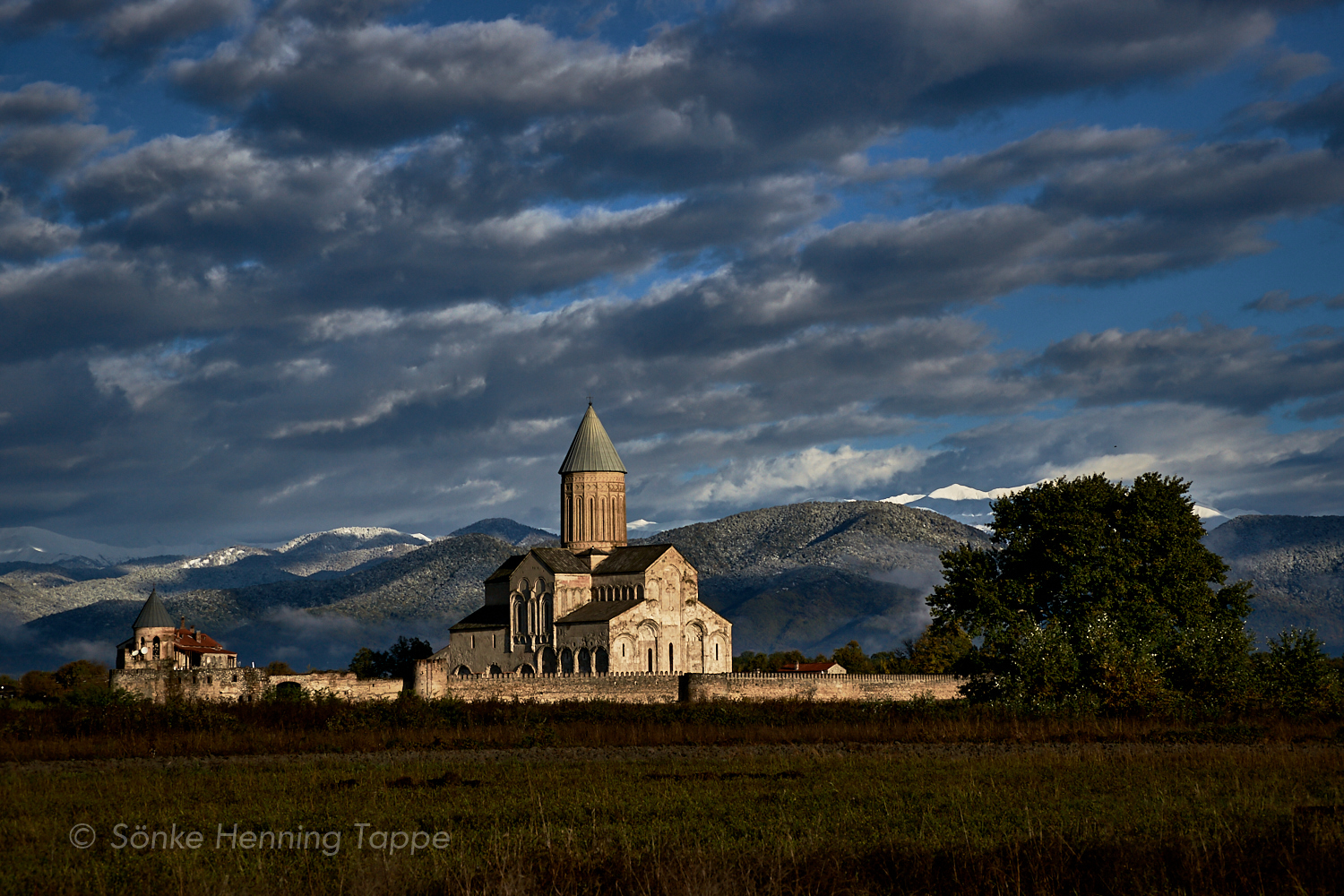
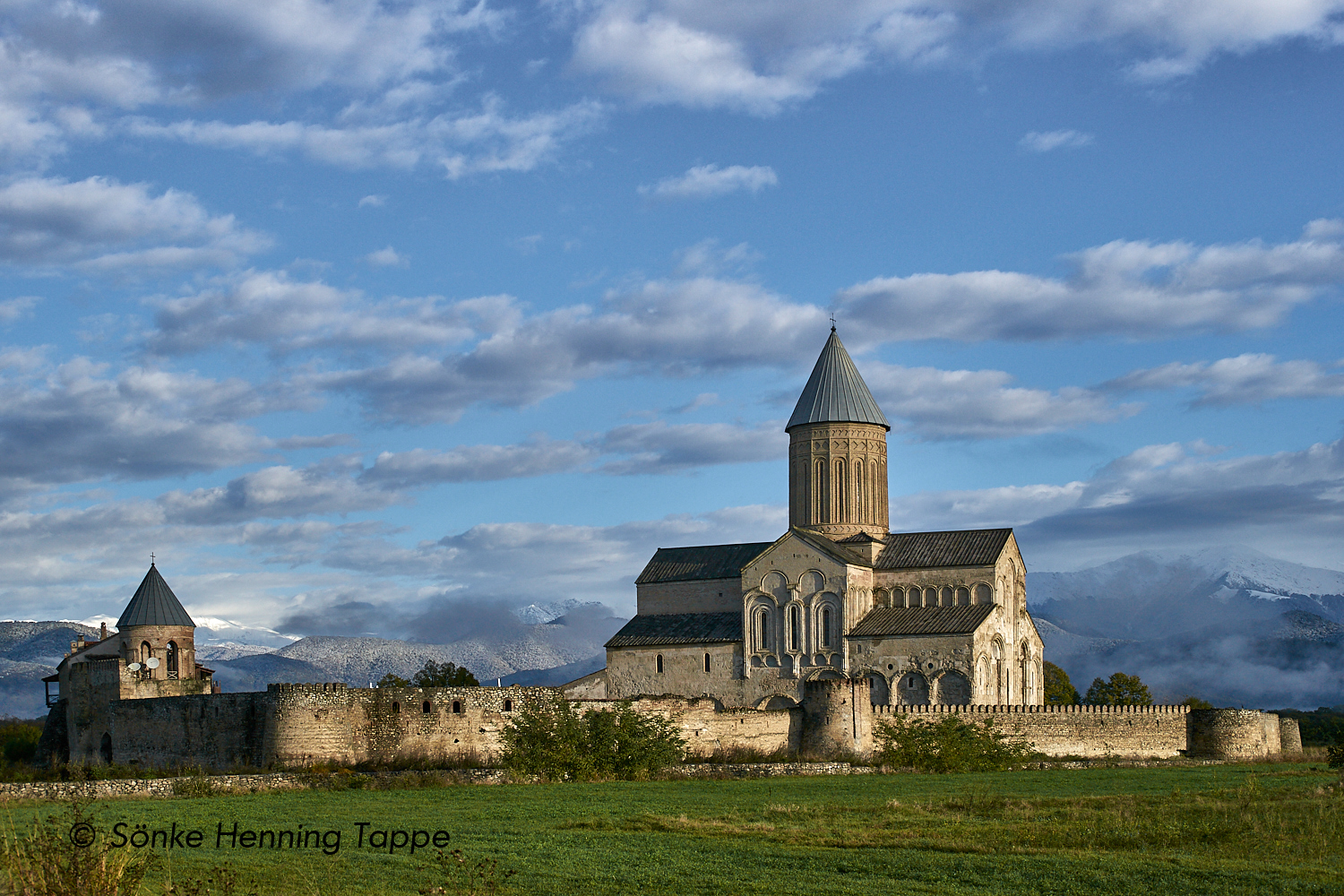
Church of Alaverdi / Alawerdi-Kirche
Alaverdi is one of the most famous churchs of Georgia. It is located in the eastern end of Kacheti. With more 50 meters of hight, it is the talest georgian church. Built in the 11th / 12 th century, it faced numerous attacks by foreign invaders. Therefore, it is surrounded by strong walls which give the impression of a fortress. Alaverdi is dedicated to the national patron, Holy St. George.
Alawerdi ist eine der berühmtesten Kirchen Georgiens. Sie findet sich am östlichen Ende von Kachetien. Mit mehr als 50 Metern ist sie die höchste georgische Kirche. Erbaut im 11. / 12. Jahrhundert, überstand sie zahlreiche Angriffe feindlicher Truppen. Deswegen ist sie umgeben von starken Befestigungsmauern, die an eine Burg erinnern. Alawerdi ist dem Nationalpatron Georgiens, dem Heiligen St. Georg, geweiht.
![]() |
| entrance-hall / Eingangshalle |
If you like this please Link Back to this article...
Subscribe to:
Posts (Atom)