Showing posts with label South-Ossetia. Show all posts

Russia is starting large-scale evacuation from occupied Georgian regions

Russia is starting large-scale evacuation from occupied Georgian regions By Namotam | Posted August 2, 2012 | Tskhinvali Women, children and the elderly are being taken out of Tskhinvali, say the residents of Gori Region, which borders with the breakaway South Ossetia...

CNN iReport

If you like this please Link Back to this article...


Shaun Walker (The Independent, Moscow): Viewing Georgia from both sides


Even though some eight months have passed since Russia's war with Georgia over the breakaway republic of South Ossetia, both parties are still feeling its consequences and remain very sensitive to interpretations of these events that appear in the media. While the Russians continue to blame the Georgians' aggression (and even made a movie about it), the Georgians insist that they have fallen victim to a bully. Anyone who believes the truth to be somewhere in between is said to belong to the enemy camp.

...

Probably nothing has done more to convince many Russians that the Western media are anti-Russian; meanwhile the one-sidedness of Russia Today or other Russian TV channels on the conflict leaves me feeling queasy.

But contrary to what many Russians seem to think, suggesting that Russia may not have covered itself in glory in South Ossetia doesn't imply support for Saakashvili.

I've always been a bit of a Saakashvili-sceptic, and it's true that a lot of the Western reporting on Georgia before last summer was rather naive and tended to take all the noble words the Georgian president said about democracy and neo-imperialism at face value, while ignoring some of the less savoury aspects of his regime.

But I think that since the war, the Western media - or the printed media at least - have struck a reasonable balance, reporting on the atrocities that were carried out by Ossetians under the eyes of Russian troops, covering various pieces of evidence that suggest that Russia was looking to provoke a conflict all along, while at the same time accepting that Georgia was responsible for sparking the war and waking up to the real nature of Saakashvili's regime.

...

As so often in international relations, the truth is surely that both sides behaved appallingly. Last year's war was rather like an obnoxious little kid picking a fight with the school bully and getting crushed. That the bully had been behaving badly before doesn't make the kid any less obnoxious, and vice versa."

Read the full article on Moscow News.

Shaun Walker is the Moscow correspondent of The Independent

If you like this please Link Back to this article...


BBC: Georgia accused of targeting civilians / BBC berichtet über georgische Kriegsverbrechen in Süd-Ossetien

The BBC has discovered evidence that Georgia may have committed war crimes in its attack on its breakaway region of South Ossetia in August. Eyewitnesses have described how its tanks fired directly into an apartment block, and how civilians were shot at as they tried to escape the fighting.
Research by the international investigative organisation Human Rights Watch also points to indiscriminate use of force by the Georgian military, and the possible deliberate targeting of civilians."
...

Aus der Zusammenfassung auf Georgien-Nachrichten:
...
"Die BBC hat am Dienstag einen Bericht veröffentlicht, der den georgischen Streitkräften beim Angriff auf die abtrünnige Teilrepublik Südossetien Kriegsverbrechen vorwirft. Dabei stützt sich die BBC auf Zeugenaussagen, die vor Ort aufgenommen worden sind. Die georgische Regierung wies die Darstellung des Senders zurück.
Dabei berichtete die BBC darüber, dass die georgischen Streitkräfte aus ihren Panzern heraus auf Wohnhochhäuser geschossen hätten. Als die dort wohnenden Zivilisten flohen, sei auf sie geschossen worden.
Die BBC stützt sich dabei auch auf Recherchen von Human Rights Watch (HRW). Mitarbeiter von HRW hatten bereits wenige Tage nach dem Ende der Kampfhandlungen vor Ort recherchiert.
"


"Your reserve - the country's reserve". Seen end of August 2008 on the street from the center to the airport (since 2005: George-Bush-Boulevard)

"Deine Reserve - die Landesreserve". Gesehen Ende August auf der Straße, die vom Zentrum zum Flughafen führt (seit 2005: George Bush-Boulevard)


If you like this please Link Back to this article...


What's in the news for Georgia and Armenia today

South-Ossetian leader Kokoity: "The bias of international observers is clear. Their activities are not helping the situation, they are making it worse".

Full article (AFP) here.


Spain Calls for Closer EU-Georgia Ties: "We are working on certain practical steps of visa facilitation, some free-trade relationship, but I think we need a political signal... and this signal could be a potential agreement between Georgia and the European Union."

Full article (Deutsche Welle) here.


Spain: Georgia should get NATO membership: "Spain will champion Georgia's bid to join NATO and build closer ties with the European Union when Madrid takes the EU's rotating presidency in 2010, the Spanish foreign minister said Saturday.

Miguel Moratinos also pledged to increase ties with Georgia and spoke forcefully in defense of its territorial integrity.

"Always, Spain has defended this principle, not like other countries that consider that this principle can be used in certain circumstances," he said at a news conference."

Read the full article here.

Obama or McCain - who is better for Armenia? "...both candidates have issued statements intended to solicit the votes and financial support of Armenian-Americans. Both have praised Armenians for their significant contributions to America. They have addressed the tragedy of the Armenians in the Ottoman Empire, but the glaring difference between the two is over the use of the word “genocide.” McCain carefully avoided the term, but Obama did not hesitate to call the calamity of 1915, genocide. He said, “The Armenian Genocide is not an allegation, a personal opinion or a point of view, but rather a widely documented fact supported by an overwhelming body of historical evidence. The facts are undeniable.”

Moreover, the statements of both candidates on contemporary Armenian issues differ as well. McCain said he “appreciated Armenia’s support of coalition forces in Iraq and Kosovo” and added that in his visits to Armenia he was impressed with “the tremendous progress made in very difficult circumstances,” difficulties which he did not identify. On the other hand, Obama showed no hesitation to state the causes of hardship. He said, “I will promote Armenian security by seeking an end to the Turkish and Azerbaijani blockades, and by working for a lasting and durable settlement of the Nagorno Karabakh conflict that is agreeable to all parties.” The reaction to these statements in Baku and Ankara showed wide concern about Obama’s strong support for Armenia’s security future. Press accounts clearly were fearful of an Obama presidency.

Under a McCain Administration, the current attitudes in Washington towards the South Caucasus will continue to tilt towards Baku for reasons of energy resources and Azerbaijan’s proximity to a problematic Iran. Bush and McCain demand wider sanctions against Tehran and view Iran as a threat to the security of Israel and American interests in the Middle East. Obama’s stated willingness for direct talks with the Iranian regime has been derided by the McCain campaign as evidence of weak leadership.

Under these circumstances, the Armenian government faces valid security concerns. Yerevan should be aware that a McCain Administration is likely to continue the current cozy relations with Azerbaijan. Washington views Caspian oil as an alternative source of petroleum be that from the Middle East or Russia. This reality is the prime motivation for Washington’s Caucasus’ policy. And there is also the legitimate worry that America’s silence at Baku’s rapid militarization and large-scale arms sales from Israel is a growing security problem for Karabakh and Armenia."

Read the full article here.

If you like this please Link Back to this article...


Saakashvili: "Level of democracy is a matter of our national security”

“Transparent election is a matter of our prestige,” he pointed out and added that Georgia should not give a reason to the international community to say that Georgia is not a democracy. He suggested that lack of democracy in Georgia would give a pretext to EU to stop pressuring Russia over Georgia. “So level of democracy is a matter of our national security as well,” he added.

Seven parties are contesting for 18 seats in the Adjara Autonomous Republic’s local parliament – the Supreme Council.

Two of them – Christian-Democratic Party; On Our Own are parties which make up the parliamentary minority. Other five parties are: the ruling National Movement Party; the Georgian Troupe; Industrialists; the Georgian Politics and United Communist Party of Georgia.

Most of the opposition parties, including those which were part of the opposition coalition, have decided to boycott the elections. Although the Conservative Party decided to undergo a formal registration, it said it did so to use the televised airtime allocated for the parties during the electoral campaign to call on voters for the boycotting and for pushing its other agendas.

The opposition parties mainly cited the new political realities, which they said, had emerged in the country after the August war behind their decision to boycott the Adjara polls (Labor Party, however, announced about its boycott before the August). Parties which were part of the opposition coalition, as well as the Republican Party, say that there are other priorities now than the local elections in Adjara, including working out a joint opposition tactic to achieve earlier general elections.

The opposition parties say they are holding consultations on the matter, but they have not yet produced a joint view on the tactics. Most of them agree that the anniversary of the break up of protest rally a year ago by the authorities should be marked on November 7 with a protest rally; but it remains unclear yet whether it will be just a symbolic demonstration or the opposition will also use the rally to push for the political demands – including the one on early parliamentary elections."


Read the full article on Civil Georgia: "Saakashvili on Opposition Boycott of Adjara polls"


If you like this please Link Back to this article...


Former Putin advisor says: "President Saakashvili's decision to move against Tskhinvali "was self-defense, though it was quite a risky self defence"

"Currently a senior fellow with the Washington-based Cato Institute, [Andrei Illarionov ] Putin's former senior economic advisor in 2000-2005 said that contrary to how it is being portrayed, the conflict did not begin on 7 August 2008, but was carefully planned and built up since the spring of 2004, when the Russian authorities started supplying South Ossetia and Abkhazia with military equipment and training their military forces, building military bases and strategic highways and railroads.

"The build up culminated with the amassing of 80,000 regular troops and paramilitaries close to the Georgian border, at least 60,000 of which participated in the August war," he explained.

"On 7 August it is estimated that 20,000 to 25,000 Ossetian and Russian troops and 240 tanks were in South Ossetia," he said, adding that the Georgian army has altogether 29,000 troops and 200 tanks, with the main part being stationed to the west facing Abkhazia.

"In the proximity of South Ossetia there were perhaps only 4,000 to 5,000 troops and 42 Georgian tanks," Mr Illarionov said, reminding that president Mikhail Saakashvili declared unilateral ceasefire on 7 August, only to see unprecedented shelling of the Georgian villages in South Ossetia that night.

"All of a sudden they understood that if the Ossetian-Russian troops move, it could be a matter of hours for them to get to Tbilisi."

President Saakashvili's decision to move against Tskhinvali "was self-defense, though it was quite a risky self defence," Mr Illarionov said.

"Saakashvili had received a very clear signal from the West - that America and Europe would not help. Even if the US would have decided to help, it was completely unrealistic, because it would have taken at least two weeks to deploy the very first troops. And it was very clear that 2 weeks was too late to defend Georgia. That is why he took this decision, clearly understanding that he would be left alone in front of Russia," he explained."

Read the full article on EUobserver.


If you like this please Link Back to this article...


Reuters: "Russland lässt OSZE-Beobachter in Zone um Südossetien gewähren"


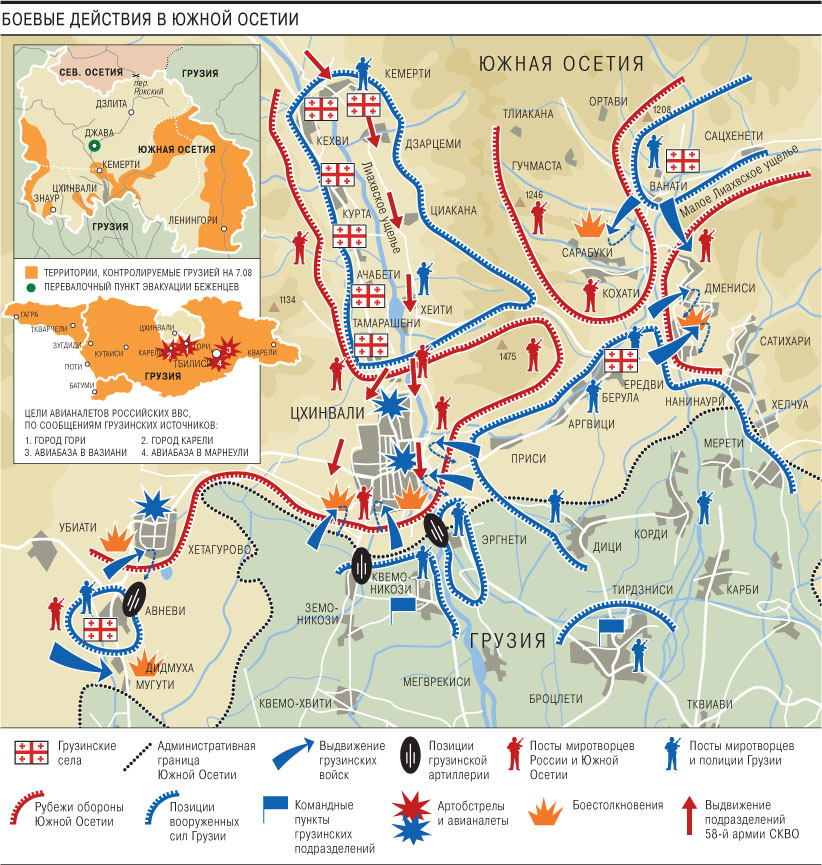
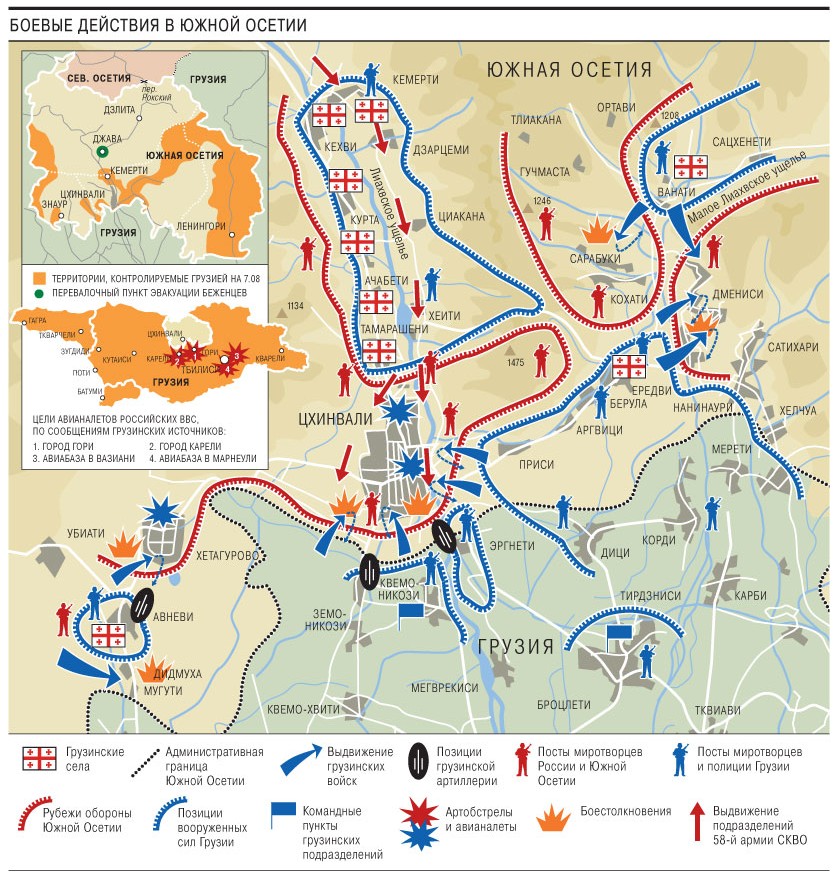
Above you see a chart by UNOMIG, showing damages to Tskhinvali and the villages north on 19th August. The majority of inhabitants of these villages were Georgians. The damages shown were caused by artillery, bombardments and / or lootings.

See Georgiennachrichten: "Russische Besatzungstruppen in Georgien behindern Diplomaten der OSZE"

The article states that special representative Goran Lennmarker was not given access to the georgian villages within South Ossetia, just like the french ambassador to Georgia as well as other representatives of the OSCE before. According to eye-witnesses, lootings go on under protection of the russian military.

Update: Today, Reuters deliver news that OSCE has been given unlimited access in the buffer zone.

A russian map about the South-Ossetian conflict can be found here: Komersant and uddebatt. Most interesting is the little map in the upper left corner. The orange marked areas were regions with a majority of Georgians. In the south-east corner of the district of South-Ossetia or Shida kartli by georgian name, you will find the russian name "Leningori" for what is in Georgia, since the fall of communism, again called "Achalgori" (meaning "new Gori"). This is where the datcha of my parents in law stands; my wife will probably never see the house of her beloved grandmother again, where she spent all summers. When she was a child, children of georgian and ossetian origin played together. The sister of my father in law, who together with her husband and relatives spent three days and nights in the woods fearing ossetian paratroopers, might never see her house again, which is located a few miles up north, not far from Ikoti.

It is interesting to notice that russian military blocks the road to Akhalgori, stands in Poti, still holds Senaki and Zugdidi and so on, while on the other hand side the russian government signed the six points for withdrawl. On 27th August, Russian foreign minister claimed that Russia was "in full compliance" with the peace deal.

Uddebatt also shows this interesting map. This is what the Russians understand as their "peace zone". Just follow the road from Gori to the west and you´ll see the russian controlled zone just right to the north of the main route from west Georgia to east Georgia. Furthermore, take into account that the Russians still occupy Poti and Zugdidi (and, as reports from journalists, who´ve been there, aren´t likely to withdraw soon), it becomes clear, what Moscow interprets as peace:

1. Annexation of Abchasia and South-Ossetia as of before this war (calling it "independece")
2. Annexation of those areas of South-Ossetia (or Shida Kartli), that weren´t unter South-Ossetian control before
3. Control over Poti, the port to international commerce
4. Control over Zugdidi, therefore gaining complete control over the north-west of Georgia (region of Svaneti)
5. Control over the east-west highway, the main connection between east and west Georgia.

Meanwhile, german foreign minister Steinmeier, a close intimate with Gerhard Schröder, who now earns his money from Gazprom, still dreams of a common strategic architecture with Russia. Holy simplicity! (Ok, I promise I will never polemize again against Mr. Steinmeier, if he promises never ever to be employed by Gazprom.) I´m sure, the Kremlin´s halls echo long lasting laughters of Putin, Medvedev, Lavrov & Co.


If you like this please Link Back to this article...


Der Artikel "Eine herrenlose Rakete"

erschienen in Telepolis vom 22.8.07, schildert den jüngsten Konflikt zwischen Georgien und Russland und bettet ihn in die jüngere Geschichte ein. Unbedingt lesenswert!

Hier klicken...


If you like this please Link Back to this article...


House in Truso Valley - Haus im Truso-Tal


This is one of the very few inhabited houses in the last (?) village of Truso-valley. The mountains are definitely ossetian (seperatist) area that claims to be independent. The tent on the lower mountain-slope probably hosts border guards - Georgians or Ossetians?

Dies ist eines der sehr wenigen bewohnten Häuser im letzten (?) Dorf des Truso-Tals. Die Berge im Hintergrund gehören zum separatistischen Gebiet Süd-Ossetien, das auf Unabhängigkeit von Georgien besteht. Das Zelt beherbergt wahrscheinlich Grenztruppen - georgische oder ossetische?


If you like this please Link Back to this article...


Crosses in Truso-Valley / Kreuze im Truso-Tal

Cross-stone with cyrillic letters near the first ossetian village behind Kobi.
Kreuzstein mit kyrillischer Inschrift nahe dem ersten ossetischen Dorf hinter Kobi.


(Reviewed / Verändert:)

Where the valley opens, you can see from far this cross-stone with two slavic crosses (note the pedestal!). Evidence to ossetian culture?

Wo sich das Tal öffnet, begegnet man auf freiem Feld diesem Kreuzstein mit zwei slawischem Kreuzen (Sockel!). Ein Hinweis auf einst ossetisch besiedeltes Gebiet?

If you like this please Link Back to this article...


Truso Valley - Das Truso-Tal


Auf der Georgischen Heerstraße, ungefähr 15 km südlich von Kasbegi im Kaukasus gelegen, sieht Kobi aus wie der letzte Vorposten der Zivilisation. Wenn man sein Auto im ersten Dorf hinter Kobi parkt (etwa 5 km die Abzweigung und der Schlaglochpiste nach), sollte man ein paar von den Männern fragen, die fühlen sich dann für das Auto verantwortlich. Ein bisschen Russisch wird sicher nicht unwillkommen sein. Man wandert nach Westen, das Tal wird bald enger und macht ein paar Biegungen bis es sich in diese Ebene öffnet. Von hier sieht man die Berge Süd-Ossetiens. Als wir im Juli weiter marschiert sind, kam uns ein israelisches Paar entgegen, das ziemliche Angst hatte vor einem halben Dutzend unfreundlicher und bewaffneter Männer, die sie nach ihren Pässen gefragt hätten. Mehr zu dieser Geschichte in einem der nachfolgenden Bildbeschreibungen.

Das nächste Bild wurde hinter dem Dorf gemacht, das man am Ende der "Straße" erkennt.

On the georgian military road, about 15 km south of Kasbegi in the Caucasus, Kobi looks like the last forepoint in the wilderness. Take the turn-off, follow the potholes and park your car near the little river. When I was there in summer 05, it was possible to cross the river and park the car in the village over the river. It is an Ossetian settlement. If you ask some Ossetian men if it´s possible to park the car in a certain place, they will feel responsible for their guests. Some words of Russian should be appreciated. Hike to the west, the valley will make some turns and finally opens up to this plain. From here you can see the mountains of South-Ossetia. When we marched further in July 2005, an Israeli couple reached us terrified, because they had met half a dozen unfriendly armed men who asked them for their passports. This story will be continued.

The next photo was shot behind the village that you see in the center of the picture.


If you like this please Link Back to this article...