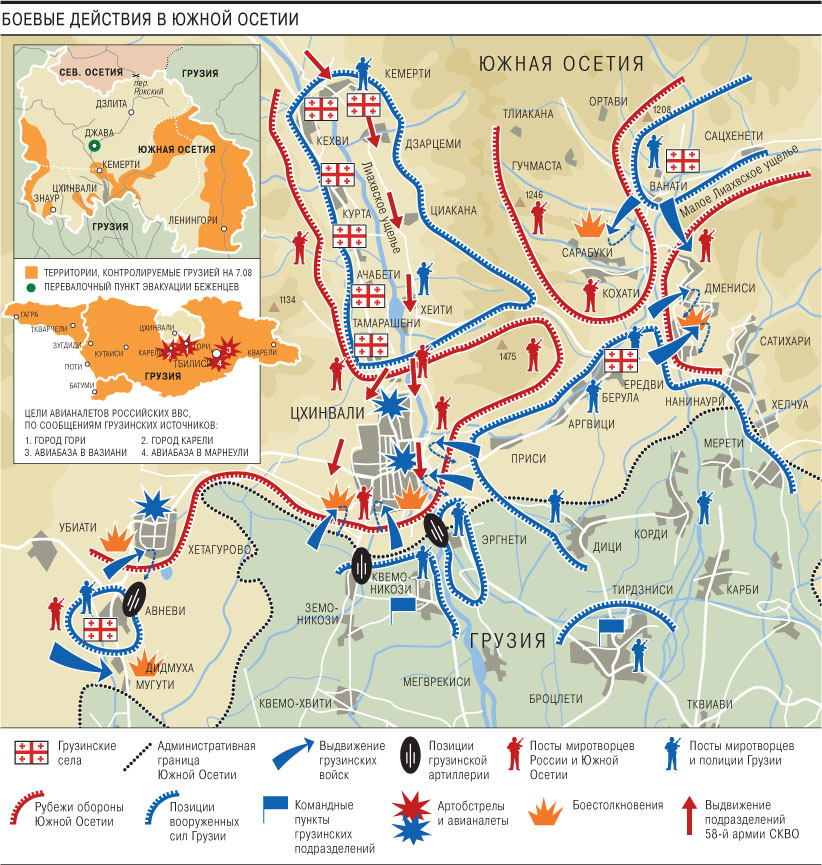
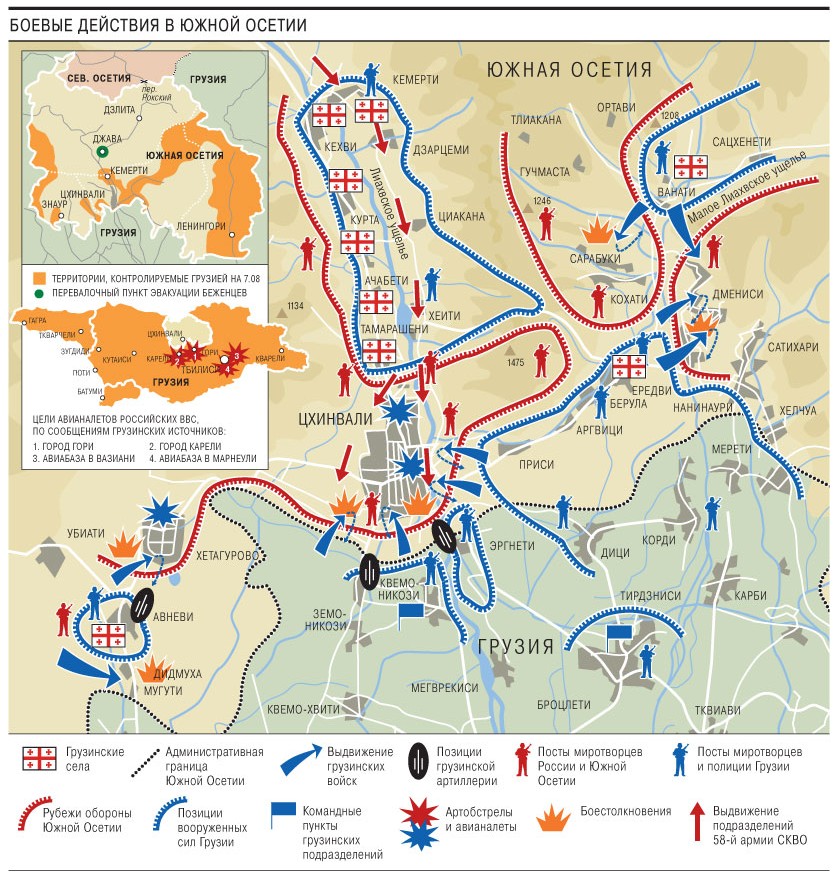
Above you see a chart by UNOMIG, showing damages to Tskhinvali and the villages north on 19th August. The majority of inhabitants of these villages were Georgians. The damages shown were caused by artillery, bombardments and / or lootings.
See Georgiennachrichten: "
Russische Besatzungstruppen in Georgien behindern Diplomaten der OSZE"
The article states that special representative Goran Lennmarker was not given access to the georgian villages within South Ossetia, just like the french ambassador to Georgia as well as other representatives of the OSCE before. According to eye-witnesses, lootings go on under protection of the russian military.
Update: Today,
Reuters deliver news that OSCE has been given unlimited access in the buffer zone.
A russian map about the South-Ossetian conflict can be found here:
Komersant and
uddebatt. Most interesting is the little map in the upper left corner. The orange marked areas were regions with a majority of Georgians. In the south-east corner of the district of South-Ossetia or Shida kartli by georgian name, you will find the russian name "Leningori" for what is in Georgia, since the fall of communism, again called "Achalgori" (meaning "new Gori"). This is where the datcha of my parents in law stands; my wife will probably never see the house of her beloved grandmother again, where she spent all summers. When she was a child, children of georgian and ossetian origin played together. The sister of my father in law, who together with her husband and relatives spent three days and nights in the woods fearing ossetian paratroopers, might never see her house again, which is located a few miles up north, not far from Ikoti.
It is interesting to notice that russian military blocks the road to Akhalgori, stands in Poti, still holds Senaki and Zugdidi and so on, while on the other hand side the russian government signed the six points for withdrawl. On 27th August, Russian foreign minister claimed that Russia was "
in full compliance" with the peace deal.
Uddebatt also shows
this interesting map. This is what the Russians understand as their "peace zone". Just follow the road from Gori to the west and you´ll see the russian controlled zone just right to the north of the main route from west Georgia to east Georgia. Furthermore, take into account that the Russians still occupy Poti and Zugdidi (and, as reports from journalists, who´ve been there, aren´t likely to withdraw soon), it becomes clear, what Moscow interprets as peace:
1. Annexation of Abchasia and South-Ossetia as of before this war (calling it "independece")
2. Annexation of those areas of South-Ossetia (or Shida Kartli), that weren´t unter South-Ossetian control before
3. Control over Poti, the port to international commerce
4. Control over Zugdidi, therefore gaining complete control over the north-west of Georgia (region of Svaneti)
5. Control over the east-west highway, the main connection between east and west Georgia.
Meanwhile, german foreign minister Steinmeier, a close intimate with Gerhard Schröder, who now earns his money from Gazprom, still dreams of a common strategic architecture with Russia. Holy simplicity! (Ok, I promise I will never polemize again against Mr. Steinmeier, if he promises never ever to be employed by Gazprom.) I´m sure, the Kremlin´s halls echo long lasting laughters of Putin, Medvedev, Lavrov & Co.