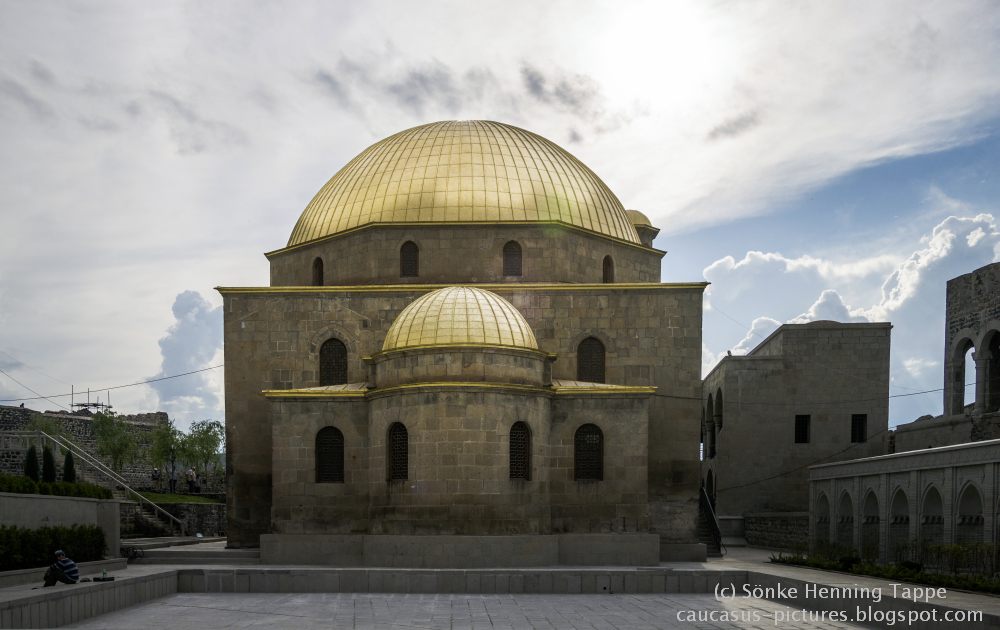
Greek: Apsaros, Latin: Apsirtus, in the 10th century: Akampsis, since the 14th century: Gonio.The castle is located 15 km south of Batumi and 4 km north of the turkish border. The castle 222 m long and 195 m wide.
Griechisch: Apsaros, Lateinisch: Apsirtus, im 10. Jh. Akampsis, seit dem 14. Jh. Gonio. Die Burg liegt 15 km südlich von Batumi und 4 km nördlich der türkischen Grenze. Die Burg ist 222 m lang und 195 m breit.
The name derives from one of the characters of the myth of the Argonauts (Apsaros = brother of Medea). The earliest archeological layers date back to the 8th and 7th century BC. A cemetary of the 5th century BC, south of the castle, was established by the colchic kingdom.
Plinius II was the first to mention Apsirtus in the 1st century AD. In the second half of the 1st AD, the high walls were built. Gonio became a center of roman culture and imperial power (with up to 1500 soldiers) until the 4th century, featuring a theater and a hippodrome.
In the mid 6th century, Gonio became a byzantine stronghold, in the 12th century a part of the Georgian kingdom. In the 16th century, an ottoman garrison was stationed in Gonio. After the russian-turkish war of 1877-78 Gonio became georgian again.
Der Name stammt aus der Argonautensage. Apsaros war der Bruder von Medea. Die frühesten archäologischen Zeugnisse stammen aus dem 8. und 7. Jh. v. Chr. Ein Friedhof, südlich der Burg gelegen, weist auf das Kolchische Königtum hin (5. Jh. v. Chr.).
Die älteste Erwähung von Apsirtus findet sich bei Plinius dem Jüngeren. Die Mauern wurden ab Mitte des 1. Jh. n.Chr. erbaut. Gonio wurde (bis ins 4. Jh.) kulturelles und militärisches Zentrum des östlichen Schwarz-Meer-Raumes, mit Theater, Hippodrom und 1000 bis 1500 stationierten Soldaten.
Mitte des 6. Jhs. wurde Gonio eine byzantinische Festung. Im 12. Jh. fiel es in den Besitz der georgischen Könige. Im 16. Jahrhundert wurde eine osmanische Garnison hier stationiert. Nach dem türkisch-russischen Krieg von 1877 bis 1878 wurde Gonio wieder georgisch.
There are speculations about the grave of St. Matthias, one of the 12 apostels, to be found on the grounds of Gonio castle.
Es heißt, Sankt Matthäus, einer der 12 Apostel, sei hier begraben worden.

The wall. Very well preserved.
Die Mauer, sehr gut erhalten

There are still some fundaments to be seen inside, but no signs giving information.
Es gibt im Inneren einige Fundamente zu sehen. Leider fehlen Info-Tafeln.

parts of the area are used for fruit- and vegetable-growing - here: kiwi-trees
Teile der Anlage werden für Obst und Gemüse verwendet. Hier: Kiwi-Bäume

ruins of a tower, part of the wall
Ruinen eines Turmes, der in die Mauer eingelassen war

Remains of the bath-house
Überreste eines Badehauses

Loopholes of modern times
Schießscharten aus jüngerer Zeit
If you like this please Link Back to this article...